Search Classroom 15X, and you’ll find two completely different results competing for attention. One is a browser game hub students open during free periods. The other is a modern teaching framework educators use to boost engagement. This guide breaks down both meanings, so you know exactly what you’re looking for.
Whether you landed here to find a game link or to understand a new teaching model, you’re in the right place. We’ll cover how each version of Classroom 15X works, what makes it popular, and how to think about using it wisely.
What Is Classroom 15X?
Classroom 15X isn’t one single product. It’s a name that has attached itself to two unrelated trends in school technology. Understanding which one you need saves time and avoids confusion.
Two Meanings, One Search Term
The first meaning is a gaming website built for students who want quick, browser-based entertainment. The second is a pedagogical framework designed to multiply student engagement through adaptive tools. Both share the “15X” branding, but they serve completely different audiences and goals.
Classroom 15X as an Unblocked Gaming Platform

For many students, Classroom 15X is simply a website. It hosts casual, browser-based games that load instantly without downloads or installs. The appeal is speed: click a link, and the game runs right in the tab.
The platform is built with lightweight code, which matters a lot in a school setting. Most school-issued Chromebooks and tablets have limited processing power, so games need to be simple and fast-loading. Classroom 15X games avoid heavy graphics and large files, which keeps performance smooth even on older hardware.
Popular Games on Classroom 15X
The game library leans toward short, replayable titles rather than long campaigns. Common favorites include:
- OvO—a fast-paced parkour and platforming game
- Minecraft Classic—a stripped-down browser version of the original sandbox game
- Stickman Hook—a swinging, physics-based arcade game
- Slope—an endless runner with simple one-touch controls
- Tiny Fishing—a relaxed clicker-style fishing game
These titles share a common thread: quick sessions, low learning curve, and instant replay value.
Why It Runs Well on School Chromebooks
School devices are often locked down with limited storage and processing power. A game that demands heavy downloads or graphics-intensive rendering simply won’t run well. Classroom 15X games are built around HTML5 and lightweight JavaScript, which keeps file sizes small and load times fast, even on shared network bandwidth.
Classroom 15X Mirror Sites and Access Points
Because school IT departments regularly update content filters, gaming sites like this one often appear under multiple domain names. This isn’t unusual in the browser-game space — it’s a common workaround for keeping a service reachable.
GitHub and Google Sites Versions
Two frequently mentioned access points are Classroom 15X GitHub and Classroom 15X Google Sites. These are typically simple static pages hosted on free platforms, often mirroring the same game library found on the main site. It’s worth noting that IT administrators set network restrictions for reasons like bandwidth management, focus, and device security, so mirror sites should be approached with that context in mind.
Classroom 15X as an Educational Framework
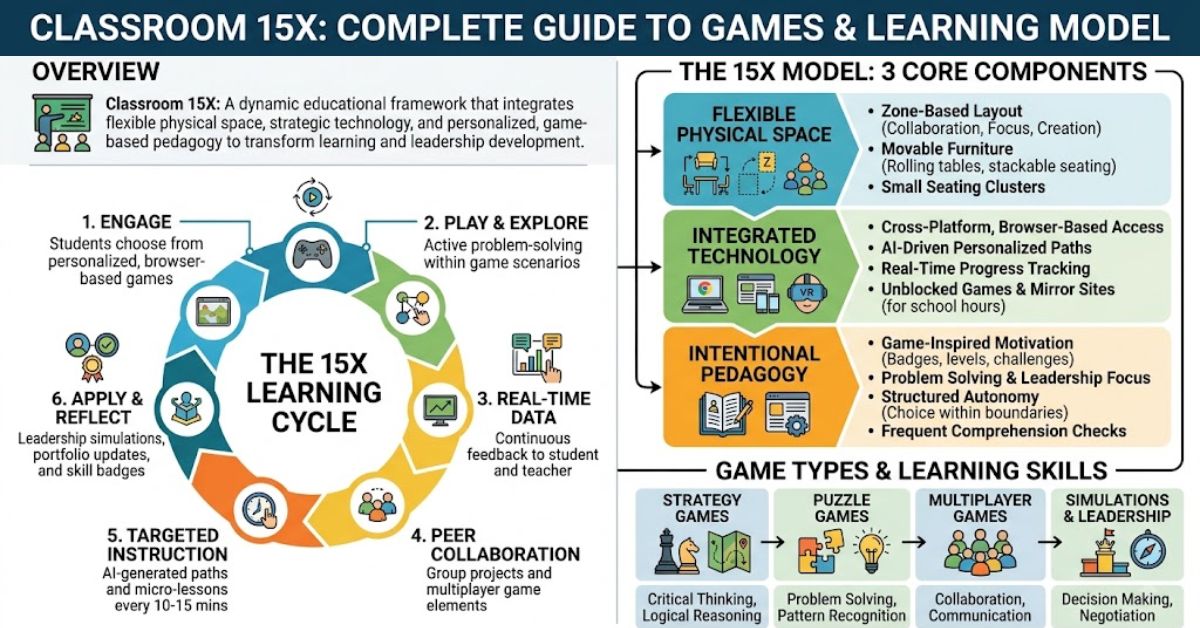
On the other side of the search results, Classroom 15X refers to something entirely different: a teaching approach aimed at dramatically increasing how much students retain and how engaged they stay during lessons. The “15x” label reflects the ambitious goal — outperforming static lecture formats by a wide margin.
Rather than a single tool, this version of Classroom 15X is a blueprint combining several classroom design principles. It blends technology, physical space, and teaching strategy into one connected system built around student feedback loops.
Adaptive Learning Explained
At the core is adaptive learning technology. Basic AI utilities monitor how a student performs on a task and adjust the difficulty in real time. If a student breezes through a concept, the system introduces harder material. If they struggle, it slows down and reinforces the basics before moving forward.
Real-Time Analytics for Teachers
Teachers using this framework get live dashboards showing student progress as it happens, not after a test the following week. This means a teacher can spot a struggling student mid-lesson and step in immediately, rather than discovering the gap during grading. Early intervention like this is one of the biggest advantages over traditional lecture formats.
Flexible Classroom Layouts
Physical space matters too. Instead of rows of fixed desks facing a chalkboard, this model favors modular furniture, collaborative “zones,” and whiteboard walls students can write on directly. The goal is to make movement and group work as natural as sitting still and listening.
Gamified Metrics and Participation
Short, auto-graded quizzes and light game mechanics — points, streaks, progress bars — turn ordinary check-ins into something students want to complete. This isn’t about turning class into entertainment; it’s about using feedback and small rewards to keep participation consistent throughout a lesson.
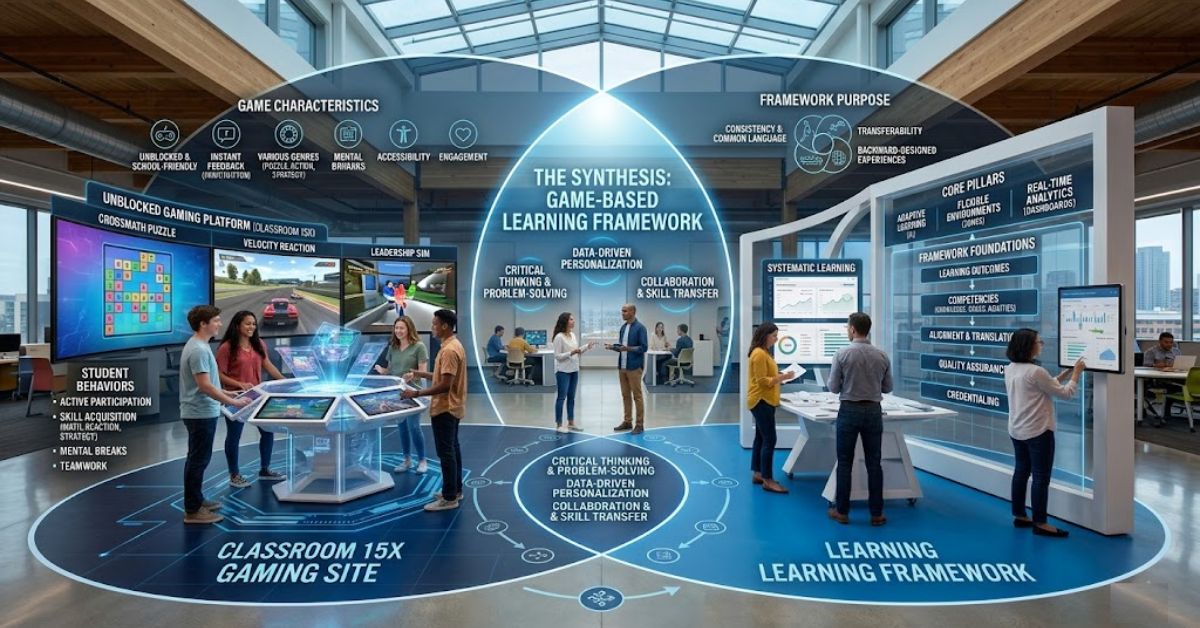
Classroom 15X Gaming Site vs. Learning Framework
| Feature | Gaming Platform | Educational Framework |
|---|---|---|
| Primary audience | Students | Teachers and administrators |
| Core purpose | Entertainment during breaks | Boosting engagement and retention |
| Technology used | Lightweight HTML5 games | AI-driven adaptive learning tools |
| Where it’s used | Browser, any device | Classroom setting, in-lesson |
| Common access points | Main site, GitHub, Google Sites | School-issued platforms and dashboards |
| Measured by | Games played, session length | Test scores, engagement analytics |
How Schools and Students Can Use Classroom 15X Responsibly
Both versions of Classroom 15X can add value when used with intention. For students, that means treating the gaming platform as a short break tool, not a distraction during instructional time. For teachers and administrators, adopting the framework means starting small and scaling what works.
A simple rollout for schools interested in the educational framework might look like this:
- Pilot adaptive learning tools in one subject or grade level
- Train teachers on reading and acting on real-time analytics
- Redesign one classroom with flexible, modular seating
- Introduce gamified quizzes for low-stakes participation tracking
- Review engagement data after a full semester before expanding
Quick checklist for educators evaluating the framework:
- Does the adaptive tool integrate with existing curriculum software?
- Can teachers access analytics without extra training overhead?
- Is the classroom layout change budget-friendly?
- Do gamified quizzes align with actual learning objectives?
- Is there a clear way to measure the “15x” engagement claim?
Conclusion
Classroom 15X means two very different things depending on who’s searching for it. For students, it’s a quick-access gaming site built for short breaks on school devices. For educators, it’s a broader framework combining adaptive learning, live analytics, flexible design, and gamified feedback to boost engagement. Knowing which Classroom 15X you’re looking for—and using it with the right context—makes it a genuinely useful part of the modern school experience.