Esports fans and aspiring players search for a lot of things: stats, rosters, tournament brackets. But more of them are now searching for something else—organizations that treat players like people, not just win totals. ProjectRethink.org Team Esports has entered that conversation. It’s built around inclusion, competitive excellence, and long-term player growth, rather than chasing a single trophy and moving on.
This guide breaks down what ProjectRethink.org Team Esports actually does, how it’s structured, and why its approach looks different from a typical competitive gaming outfit. You’ll see how the organization develops talent, what games it competes in, and how its leadership model supports players well beyond a single season.
What Is ProjectRethink.org Team Esports
ProjectRethink.org Team Esports is an esports organization structured around inclusion, competitive excellence, and long-term player growth. That’s not just a mission statement — it shapes how the organization recruits, coaches, and manages its rosters day to day.
Most competitive gaming orgs measure themselves by trophies. ProjectRethink.org Team Esports takes a broader view. It treats a tournament win as one data point among many, not the entire scoreboard. Player retention, skill development, and team culture all factor into how the organization defines success, which is a meaningful shift from the “win now, worry later” approach common in competitive gaming.
The Strategic Philosophy Behind the Organization
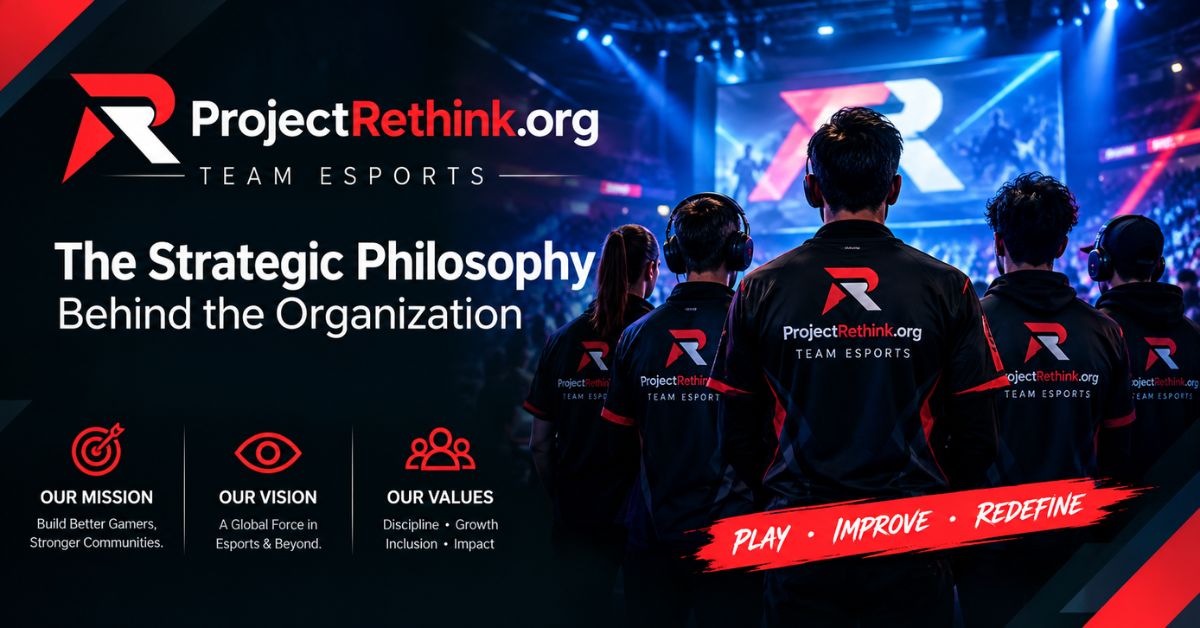
Rather than chasing singular tournament wins, ProjectRethink.org Team Esports prioritizes sustainable professional placements, transparent operations, and measurable milestone progression. In practice, that means players are evaluated on consistent growth curves, not just their best (or worst) match of the season.
This philosophy also shows up in how the organization communicates. Transparent operations mean players, staff, and fans have visibility into decisions like roster changes or coaching adjustments, instead of learning about them after the fact. Combined with measurable milestones — think skill benchmarks, communication scores, or consistency ratings — this creates a framework where progress is tracked, not assumed.
Game Titles and Competitive Focus
ProjectRethink.org Team Esports fields rosters primarily in First-Person Shooters (FPS) and Arena titles, covering formats from battle royales to team-based strategy games. This focus lets the organization build deep expertise in a specific competitive skill set rather than spreading thin across unrelated genres.
FPS Rosters
FPS titles reward split-second decision-making, map knowledge, and mechanical precision. Teams in this category typically train around:
- Aim consistency drills
- Map-specific positioning strategy
- Communication under pressure
- Round-by-round review sessions
Arena and Team-Based Titles
Arena-style and team-based strategy titles demand a different kind of coordination — synchronized rotations, shared objectives, and role discipline. Success here depends less on individual mechanics and more on how well five players move as one unit, which is why coaching in this format leans heavily on scrim review and communication training.
Player Development and Performance Metrics
The coaching staff uses specialized match metrics and player feedback loops to shape practice schedules, scout new talent, and balance rosters with veteran leaders alongside rising competitive talent. This data-informed approach means practice time isn’t guesswork — it’s targeted at whatever the numbers say needs the most work.
Feedback loops also run both directions. Players aren’t just told what to fix; they’re asked what’s working and what isn’t, which feeds back into how coaches design the next week’s schedule. That two-way process helps the organization scout new talent more accurately too, since it has a clearer picture of what skills actually translate into wins versus what just looks good in a highlight reel.
A typical development cycle might look like this:
- Collect match data and individual performance metrics
- Review footage with players and identify specific gaps
- Adjust practice schedules around those gaps
- Re-test performance in scrims or ranked play
- Update milestone tracking and repeat
Leadership and Advisory Structure
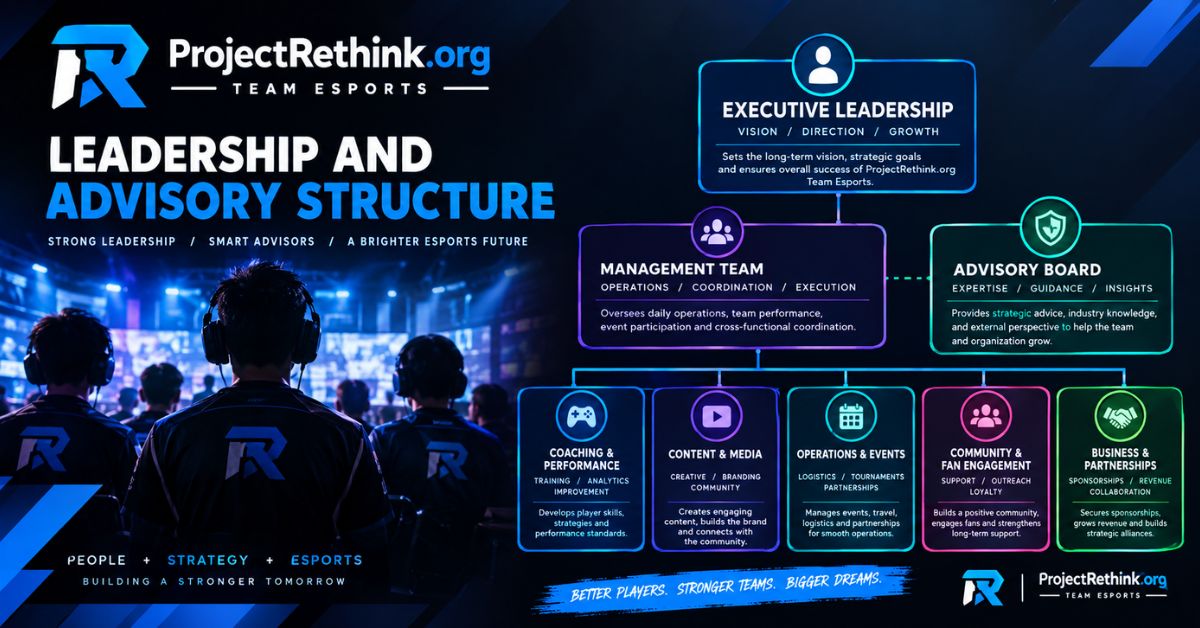
The team operates with a core unit of players and coaches, supported by an Advisory Board made up of experienced gaming and business professionals who guide the organization’s long-term operations. This two-tier structure separates day-to-day competitive decisions from bigger-picture strategy, which helps keep both running smoothly.
Coaches and team captains typically handle scrim schedules, in-game strategy, and roster chemistry. The Advisory Board, meanwhile, focuses on sustainability questions: partnerships, brand direction, and long-term player pathways. That division of labor means competitive decisions aren’t made in a vacuum, and business decisions don’t override what’s actually happening on the server.
ProjectRethink.org vs. Traditional Esports Organizations
| Factor | ProjectRethink.org Team Esports | Traditional Esports Org |
|---|---|---|
| Primary success metric | Sustainable placements & milestones | Tournament wins |
| Operations style | Transparent, milestone-tracked | Often results-only, less visibility |
| Roster philosophy | Blend of veterans and rising talent | Frequently win-now, high turnover |
| Coaching approach | Metrics-driven feedback loops | Varies, often less structured |
| Leadership | Core team + Advisory Board | Single management layer |
| Game focus | FPS and Arena titles | Often broad, multi-genre |
Why This Model Matters for Players and Fans
For players, this structure offers something a lot of competitive scenes don’t: a development path instead of a short leash. Players know what they’re being measured on and have a say in shaping their own training.
For fans, it means following a team that’s built to last rather than one that might dissolve after a rough season. That stability tends to build stronger, longer-term fan communities — something that matters as much to sponsors as it does to supporters.
Quick checklist for what to look for if you’re evaluating an org like this one:
- Clear, published philosophy (not just marketing copy)
- Evidence of milestone tracking, not just win/loss records
- A defined leadership structure beyond “the owner decides everything”
- A specific competitive focus rather than trying to do everything at once
- Active feedback channels between players and coaching staff
Conclusion
ProjectRethink.org Team Esports represents a different way of thinking about competitive gaming—one where inclusion, transparency, and player development sit alongside the scoreboard rather than behind it. By focusing on FPS and Arena titles, using metrics-driven coaching, and backing its core team with an experienced Advisory Board, the organization builds toward sustainable success instead of one-off wins.
Whether you’re a player considering where to compete or a fan deciding who to follow, ProjectRethink.org Team Esports is worth watching as a model for what a modern esports organization can look like when long-term growth is the actual goal.