
Zopalno Number Flight, you are probably trying to identify a flight, understand an unfamiliar travel term, or check a flight’s status. The confusing part is that “Zopalno” looks as though it could be an airline, airport, booking code, or specialized aviation term. Based on available aviation coding standards, however, it does not fit the normal format of a recognized flight identifier.
That distinction matters when you are traveling. Entering an incorrect term into a flight tracker can produce irrelevant results or no results at all. Instead of treating Zopalno as a confirmed airline or flight code, travelers should locate the actual carrier designator and numeric flight number shown on their booking documents. This guide explains what the phrase likely represents and what you should look for instead.
What Is Zopalno Number Flight?
The phrase Zopalno Number Flight is an unusual search term circulating on websites and in search results. There is no reliable evidence that “Zopalno” itself represents a standard commercial flight number. Searches for the term largely produce explanatory web pages rather than an identifiable airline, scheduled route, or official aviation service. That is an important distinction for anyone trying to use the phrase for real-world flight tracking.
A legitimate commercial flight identifier normally combines information identifying the carrier with a numeric flight number. IATA documentation defines a flight number as one to four digits, while airline designators are separate codes used to identify carriers. IATA’s Airline Coding Database also includes two-letter airline designators among its standard data fields.
Is Zopalno an official aviation term?
Current search results contain third-party articles discussing the phrase, but that does not make it an aviation standard. One recent article, for example, describes it as an unverified search phrase rather than a recognized commercial aviation identifier.
For travelers, the safest interpretation is simple: do not use “Zopalno” by itself to identify or track an aircraft or scheduled flight. Look for the actual airline and flight number on your booking confirmation.
Is Zopalno a Real Airline or Flight Number?

There is no good basis for treating Zopalno Number Flight as the name of a real airline or as a conventional flight number. IATA’s official coding information explains that airline designators are assigned codes used for commercial purposes such as reservations, schedules, and tickets. “Zopalno” does not resemble that standard airline-designator format.
It is also important to separate an airline code from the numeric flight number. IATA’s data model defines the flight-number field as one to four digits. In practical passenger-facing use, you will commonly see the carrier designator immediately before those digits. For example, a booking might display something like AA100, where the letters identify the carrier and the numbers identify the flight.
| Identifier | Example | What It Tells You |
|---|---|---|
| Airline designator | AA | Identifies the airline |
| Flight number | 100 | Identifies the flight |
| Displayed flight ID | AA100 | Carrier plus flight number |
| Zopalno | Zopalno | Not a standard flight-number format |
This is why travelers should not assume that every unfamiliar word appearing beside travel information represents an airline or aviation code.
Why Are People Searching for Zopalno Number Flight?
The exact origin of the Zopalno Number Flight phrase is unclear. It may have spread because unfamiliar search terms can be repeated across websites once people begin searching for them. A strange query can quickly generate articles explaining the query, which in turn makes the term appear more established than it actually is.
There are also ordinary technical explanations for seeing unfamiliar text in travel-related contexts. Websites, booking engines, data feeds, browser extensions, or third-party applications can occasionally display incomplete or incorrectly mapped information. Without evidence from the specific system where the word appeared, however, calling Zopalno a definite “placeholder” or “software glitch” would be speculation rather than established fact.
Possible explanations include:
- A spelling or transcription mistake
- Misreading another airline or airport code
- Incorrectly mapped website data
- Placeholder or test content
- Automatically generated online content
- Confusion between a booking reference and flight number
- A search phrase that became popular through repetition
The key point is verification. If the term appears on a travel page, compare that page with the confirmation issued directly by your airline or booking provider.
How to Find Your Real Flight Number
Your real flight information should be available in the documents associated with your reservation. Start with the confirmation email sent after booking. Find the section showing the airline, departure airport, destination, date, and departure time. The flight identifier should normally appear alongside these details rather than as an unexplained phrase such as “Zopalno.”
Your e-ticket and boarding pass are also useful sources. Be careful not to confuse your flight number with a booking reference, confirmation code, ticket number, gate number, or seat number. These identifiers serve different purposes. If you still cannot determine which code represents your flight, open your reservation through the airline’s official website or mobile application.
Use this quick process:
- Open your airline confirmation email.
- Find the itinerary or flight-details section.
- Identify the airline operating the flight.
- Look for its carrier code and flight digits.
- Confirm the departure date and airports.
- Enter that identifier into a flight-status tool.
For example, if your itinerary clearly lists an airline followed by flight 306, use the exact identifier displayed by the carrier. Do not substitute Zopalno Number Flight unless your airline specifically confirms what that term represents.
How to Track Your Flight Correctly
The most reliable starting point is usually the airline operating your flight. Visit its official website or app and locate the “Flight Status” section. Enter your flight number and, when requested, the travel date. This can show scheduled departure and arrival information, delays, cancellations, terminal details, and other operational updates supplied by the carrier.
Independent tracking services can provide additional information, especially when you want to follow an aircraft’s progress. FlightAware and Flightradar24 are widely used flight-tracking platforms. For time-sensitive decisions such as check-in, boarding, cancellations, or rebooking, confirm important details with the operating airline or airport rather than relying solely on a third-party tracker.
| Tracking Source | Best Used For | Recommended Priority |
|---|---|---|
| Airline website/app | Official flight status and booking details | Highest |
| Airport website | Departures, arrivals, terminals | High |
| FlightAware | Flight tracking and status research | Useful |
| Flightradar24 | Aircraft movement and live tracking | Useful |
| Random search result | General information only | Verify first |
Never enter payment information, passport details, or sensitive booking credentials into an unfamiliar site simply because it claims to identify a Zopalno flight.
Zopalno Number Flight vs. a Real Flight Number
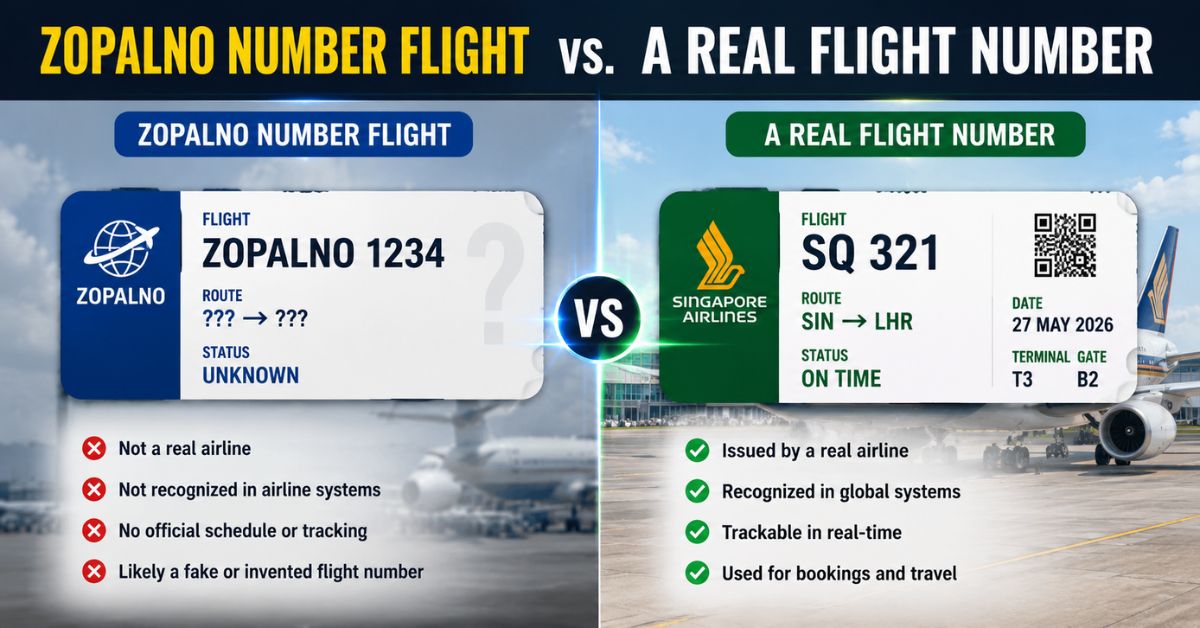
The easiest way to understand the difference is to examine the structure. “Zopalno” is a word. A conventional passenger-facing flight identifier normally uses a carrier designator with a numeric flight number. IATA recognizes two-character airline designators for commercial identification, and its flight-number data definition permits one to four digits.
For example, suppose your itinerary displays an airline code followed by 607. That structured identifier can be checked against the airline’s schedule or flight-status system. Searching only for “Zopalno,” by contrast, does not provide the carrier, route, date, or standard numeric flight information needed to confidently identify a scheduled service.
A legitimate flight search should usually give you enough information to verify:
- Airline
- Flight number
- Departure airport
- Arrival airport
- Travel date
- Scheduled departure time
If several of these details are missing, do not assume an unfamiliar phrase is enough to identify your flight.
What to Do If Zopalno Appears on Your Booking
If Zopalno Number Flight actually appears on a ticket, confirmation page, email, or travel application, first capture the context. Take a screenshot if appropriate, but avoid publicly sharing your full ticket, barcode, QR code, booking reference, or personal information. Then compare the displayed itinerary with the information in your airline’s official reservation system.
If the airline’s website shows a normal flight identifier while another website displays Zopalno, rely on the verified airline information for travel decisions. If the strange term appears in the airline’s own system or your itinerary remains unclear, contact the airline or booking agency and ask them to confirm your operating carrier and flight number.
Conclusion
The Zopalno Number Flight phrase should not be treated as a verified airline, official flight number, or standard aviation identifier based solely on its appearance in search results. Standard flight information uses recognized airline identifiers and numeric flight numbers, supported by details such as the route and travel date.
If you encounter “Zopalno,” find the actual flight identifier on your confirmation email, e-ticket, boarding pass, or airline account. Then verify it through the operating airline, airport, or a reputable flight tracker. That approach is faster, safer, and far more reliable than trying to track an unexplained search phrase.