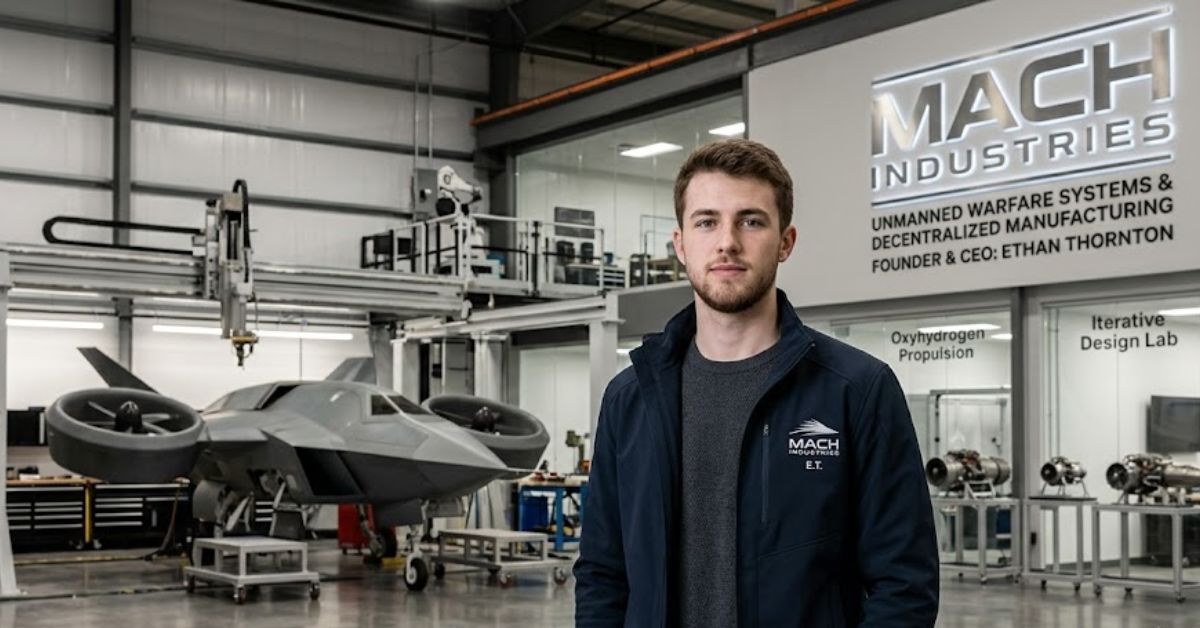
Ethan Thornton has become one of the most closely watched young founders in American defense technology. He is the founder and CEO of Mach Industries, a hardware-focused startup developing unmanned systems, propulsion technology, and manufacturing capacity for U.S. and allied defense customers.
Interest in Thornton comes from more than his age or college-dropout story. Mach Industries is attempting to solve a difficult national-security problem: how to produce capable autonomous hardware faster, at lower cost, and in much larger quantities. The company has raised roughly $485 million and is pursuing six weapons programs at the same time. That ambition has attracted major investors, government customers, strong media attention, and reasonable questions about execution risk.
Who Is Ethan Thornton?
Ethan Thornton is a defense technology entrepreneur from Boerne, Texas. He founded Mach Industries and serves as its chief executive officer. The company describes itself as a defense manufacturer for the unmanned era, with a focus on advanced autonomous systems, propulsion, and scalable production.
Public profiles often describe Thornton as a tech prodigy, but his practical background is as important as that label. He grew up building and testing projects, worked automotive jobs, and earned money through knife, furniture, and engineering sales. Those activities helped fund early experimentation. His path was hands-on from the start, combining workshop skills with a growing interest in military technology, manufacturing, and the strategic consequences of unmanned warfare.
Quick facts:
- Position: Founder and CEO of Mach Industries
- Industry: Defense technology and manufacturing
- Hometown: Boerne, Texas
- Education: Briefly attended MIT
- Primary focus: Autonomous defense systems and unmanned platforms
- Company headquarters: Huntington Beach, California
- Reported valuation: $1.8 billion as of June 2026
Early Life in Texas and His Time at MIT
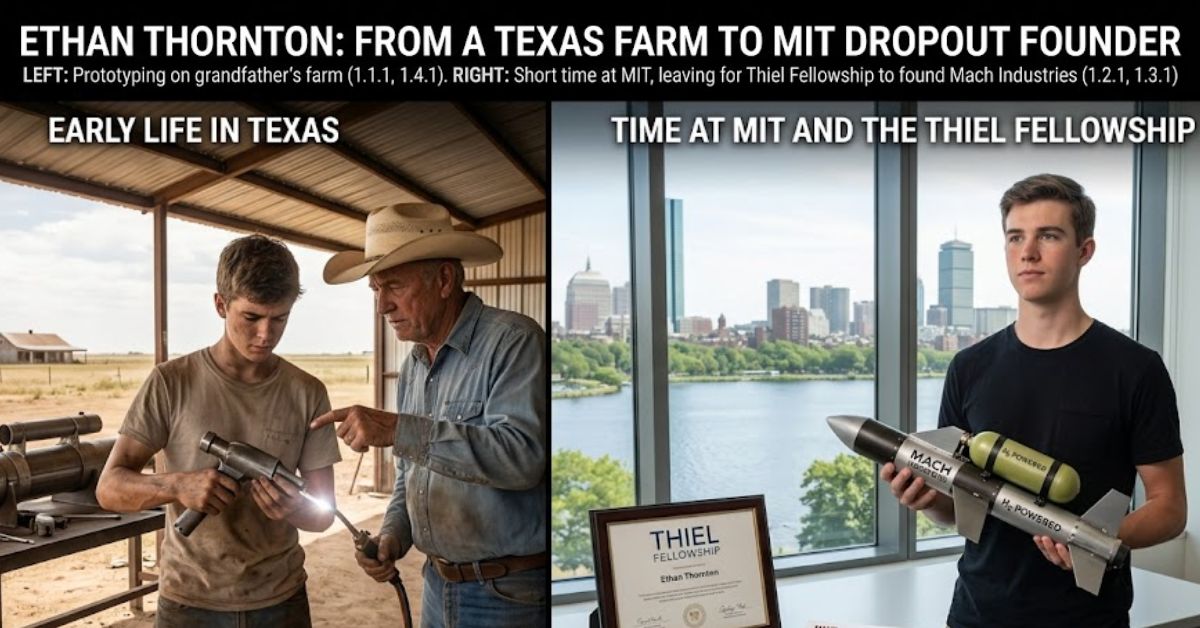
Thornton grew up in Boerne, a small Texas city, in a family with military connections. He has said that concerns about China and the possibility of a future great-power conflict shaped his thinking while he was still a teenager. He became convinced that inexpensive unmanned systems would play a larger role in warfare and that the United States needed to develop and manufacture them faster than traditional procurement cycles typically allow.
His time at the university was brief. Thornton left after one semester, at age 19, to work on Mach Industries full-time. The decision gave him more time to build, recruit, and pursue defense contracts, but it also increased the stakes. He was attempting to lead a capital-intensive weapons company without a completed degree or long industry résumé.
His early career followed a practical progression:
- He developed mechanical and workshop skills in Texas.
- He funded projects through automotive work and custom product sales.
- He joined MIT and participated in its football program.
- He left MIT to develop Mach Industries full-time.
- He began raising venture capital and pursuing military programs.
Mach Industries’ Mission and Weapons Programs
Mach Industries was founded around an aggressive goal: build low-cost, mass-producible defense hardware for an era of autonomous warfare across land, sea, and air. Its early hydrogen-powered weapons concept did not become the company’s defining product, and Thornton later acknowledged that the original hydrogen bet did not work. Mach then broadened its focus toward unmanned aircraft, missiles, propulsion, interceptors, and the industrial systems needed to manufacture them at scale.
By mid-2026, Mach was running six parallel weapons programs. Reported projects included a vertical-takeoff strike aircraft, a long-range anti-ship missile, two stratospheric systems, a lower-cost surface-to-air interceptor for drones, and a separate 40-foot Navy logistics-and-strike aircraft. This portfolio is unusually broad for a young startup.
Viper is one of Mach Industries’ most visible programs. It is a vertical-takeoff strategic-strike cruise missile developed under an Army Applications Laboratory effort, not the separate 40-foot Navy aircraft. The Army program calls for a system that can launch beyond enemy radar coverage, travel roughly 180 miles, carry a warhead exceeding 22 pounds, and use artificial intelligence for navigation and targeting. Mach has also emphasized a manufacturing cost below $100,000 at scale.
Mach’s wider product portfolio shows how the company connects vehicles, weapons, and propulsion. Publicly named systems have included Viper, Glide, and Stratos, while Mach Propulsion focuses on tactical engines. The company also develops vertical-takeoff aircraft, cruise-missile concepts, anti-drone interceptors, and long-range unmanned platforms.
| Program or capability | Reported purpose | Important distinction |
|---|---|---|
| Viper | Vertical-takeoff strategic strike | U.S. Army development effort |
| Glide | Long-range unmanned delivery system | Separate from Viper |
| Stratos | High-altitude or stratospheric operations | Part of Mach’s core portfolio |
| Anti-drone interceptor | Lower-cost surface-to-air defense | Designed to engage unmanned threats |
| Anti-ship missile | Long-range maritime strike | One of six reported programs |
| 40-foot aircraft | Navy logistics and strike missions | Not the Viper system |
Mach Industries’ Decentralized Manufacturing Strategy
Thornton’s manufacturing strategy is built around Forge, Mach Industries’ flexible and distributed production network. Instead of relying only on one enormous factory, the company wants multiple facilities that can manufacture closer to demand. The model is intended to improve survivability, shorten supply lines, and reduce the damage caused by disruption at a single site. Mach also operates Forge Huntington, a 115,000-square-foot flagship plant in Huntington Beach, California.
The basic logic is straightforward. A concentrated factory may be efficient during peacetime, but it can become a vulnerable bottleneck during a high-intensity conflict. A distributed network can shift work between locations, add capacity in smaller increments, and support faster product changes. Whether Mach can deliver those advantages at scale will depend on quality control, supplier coordination, workforce training, secure data sharing, and consistent production standards across every site.
| Manufacturing factor | Typical centralized model | Mach’s stated approach |
| Facility structure | A small number of large plants | Multiple flexible production sites |
| Disruption risk | Concentrated in major facilities | Distributed across the network |
| Production expansion | Large and expensive capacity additions | Smaller capacity additions near demand |
| Product integration | Relies on multiple supplier tiers | Greater vertical integration |
| Development process | Longer sequential programs | Faster testing and iteration |
The Forge model can be understood through four steps:
- Design systems with repeatable manufacturing in mind.
- Keep critical propulsion and engineering capabilities in-house.
- Replicate production capacity across several locations.
- Move or expand work when demand or security conditions change.
Funding, Investors, and the $1.8 Billion Valuation

Mach Industries has attracted unusually large funding rounds for a company founded in 2023. It raised a $5.7 million seed round, followed by a $79 million Series A, a $100 million Series B, and a $300 million Series C. Those disclosed rounds total about $485 million. The June 2026 Series C valued the company at $1.8 billion and was led by Infinite Capital and Ribbit Capital.
Longstanding investors include Bedrock Capital, Sequoia Capital, and Khosla Ventures. Their support gives Mach money for specialized talent, testing, factories, propulsion development, and contract execution. It does not guarantee technical success or profitable production. Defense hardware requires long validation cycles, reliable supply chains, safety compliance, and customer acceptance. The valuation therefore reflects confidence in Mach’s opportunity and team, while future results will depend on fielding systems that perform as promised.
| Funding round | Date | Amount | Reported valuation |
| Seed | June 2023 | $5.7 million | Not publicly emphasized |
| Series A | October 2023 | $79 million | $335 million |
| Series B | June 2025 | $100 million | $470 million |
| Series C | June 2026 | $300 million | $1.8 billion |
| Approximate total | 2023–2026 | $484.7 million | Commonly rounded to $485 million |
Major investors include:
- Infinite Capital
- Ribbit Capital
- Bedrock Capital
- Sequoia Capital
- Khosla Ventures
- DCVC
- Marque Ventures
Why Ethan Thornton Matters in Defense Technology
Why is Ethan Thornton receiving so much attention? The clearest answer is the combination of speed, youth, capital, and national-security relevance. Few founders leave college at 19, raise hundreds of millions of dollars, secure military development work, and build a large manufacturing operation within several years.
Is Mach Industries comparable to Anduril? Anduril is larger and has a broader software, sensor, and platform portfolio. Mach is younger and emphasizes vertically integrated hardware, propulsion, weapons, and distributed manufacturing.
Quick answers to common questions:
- Did Ethan Thornton graduate from MIT? No. He left after one semester.
- How old was Thornton when he left MIT? He was reportedly 19.
- What company did he establish? He founded Mach Industries.
- How much has Mach Industries raised? Approximately $485 million.
- What is Mach Industries worth? It was valued at $1.8 billion in June 2026.
- Is Viper a Navy aircraft? No. Viper is connected to an Army strategic-strike effort.
- Does Mach have a Navy aircraft program? Yes. It has reported a separate 40-foot logistics-and-strike aircraft.
What readers should monitor:
- Completed flight and operational tests
- Development awards compared with full procurement contracts
- Actual production volume
- Verified unit costs at scale
- Delivery deadlines
- Safety and reliability results
- Progress across all six programs
- Expansion of the Forge manufacturing network
Conclusion
Ethan Thornton’s rise reflects the growing importance of defense technology, autonomous systems, and resilient manufacturing in U.S. national-security planning. His background combines workshop experience, a brief period at MIT, and an unusually early move into company leadership. Mach Industries has gained major investors, government programs, a large California factory, and a billion-dollar valuation by promising to develop capable hardware faster and at lower cost.
The strongest case for Ethan Thornton is that he has turned a bold thesis into a funded company with real facilities and active defense programs. The main concern is execution. Mach must prove that several ambitious systems can move from prototypes and contracts into dependable production. That balance makes Thornton worth watching.