
The latest Layoffs at Microsoft affected about 4,800 roles on July 6, 2026, equal to roughly 2.1% of the company’s global workforce. The cuts reached commercial sales and Xbox, where 1,600 positions were eliminated immediately. Microsoft also announced a broader Xbox restructuring that could remove about 3,200 roles across fiscal 2027. The scale makes this one of the company’s most important workforce changes of the year.
The announcement came only days after Microsoft began its new fiscal year on July 1. That timing matters because the company often reviews budgets, headcount, and investment priorities around its annual reset. Microsoft described the decision as a way to focus resources on higher-priority opportunities. Outside analysts also connected the cuts to rising AI infrastructure costs, pressure on software margins, and the need to improve returns from the Xbox business.
What Microsoft Confirmed About the July 2026 Layoffs
Microsoft confirmed that it was eliminating around 4,800 roles, or about 2.1% of its worldwide workforce. The company said the layoffs were part of a broader transformation rather than a simple cost-cutting exercise. However, management acknowledged that artificial intelligence is changing how work is performed and where the company plans to invest.
Commercial sales teams accounted for a substantial share of the non-gaming reductions, while Xbox faced the deepest structural changes. Microsoft said 1,600 Xbox roles were cut on July 6, with approximately 3,200 positions expected to disappear across fiscal 2027. That longer restructuring represents about a 20% reduction in the gaming division’s workforce over the fiscal year.
| Confirmed item | Details |
|---|---|
| Announcement date | July 6, 2026 |
| Total roles eliminated | About 4,800 |
| Share of global workforce | About 2.1% |
| Immediate Xbox cuts | About 1,600 roles |
| Planned Xbox cuts | About 3,200 roles across fiscal 2027 |
| Other affected area | Commercial sales teams |
Why Xbox Took the Heaviest Impact
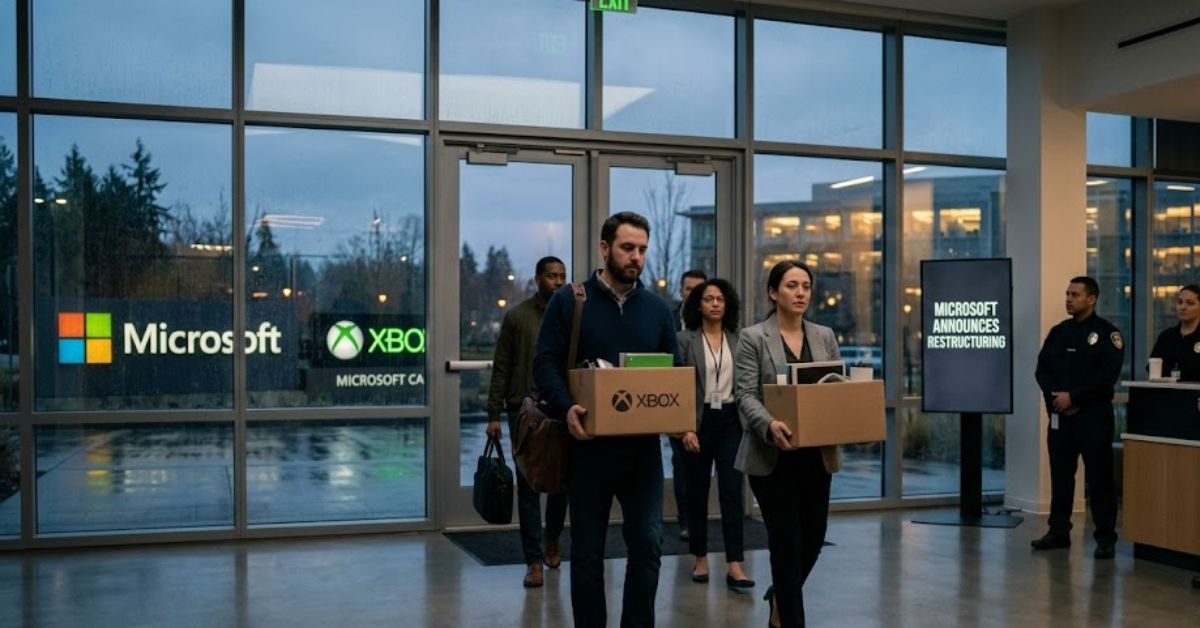
Xbox carried the largest burden because Microsoft is trying to repair a business with weaker margins, slower growth, and a costly operating structure. The company invested heavily in studios, subscriptions, hardware, and acquisitions, yet Xbox still struggled to close the competitive gap with PlayStation and Nintendo. Management concluded that the division needed fewer layers, lower vendor spending, tighter project selection, and clearer responsibility for financial performance.
Four studios will leave Microsoft’s direct ownership under the new structure. Ninja Theory and Undead Labs are moving toward new ownership with funding arrangements intended to support Senua and State of Decay 3. Microsoft also began a strategic review involving Arkane Lyon, which is developing Marvel’s Blade, making the final studio outcome less certain.
| Studio | Announced direction | Key project or franchise |
| Double Fine Productions | Returning to independent management | Psychonauts |
| Compulsion Games | Returning to independent management | South of Midnight |
| Ninja Theory | Moving to new ownership | Senua |
| Undead Labs | Moving to new ownership | State of Decay 3 |
| Arkane Lyon | Strategic options under review | Marvel’s Blade |
How AI Spending and Market Pressure Shaped the Decision
Microsoft is spending heavily on data centers, chips, cloud capacity, and other infrastructure required to support its AI strategy. Those investments may strengthen Azure and Copilot over time, but they also reduce near-term cash flow and increase pressure to control operating costs elsewhere. The layoffs at Microsoft therefore look less like AI directly replacing thousands of employees and more like a reallocation of money toward expensive AI platforms and higher-priority technical work.
Investor concern also increased during the first half of 2026. Microsoft shares fell nearly 23% during that period, while the stock lost about 18% in June alone. The decline reflected anxiety about high capital spending, uncertain AI returns, and possible disruption to traditional software products. The stock move did not cause the layoffs by itself, but it increased pressure on management to show stronger discipline and a clearer path to profitable growth.
Key financial and strategic pressures included:
- Rising AI infrastructure costs
- Slower confidence in near-term AI returns
- Pressure on free cash flow
- Weak Xbox margins and softer console demand
- Investor concerns about traditional software disruption
- A need to simplify management and reduce operating layers
The Fiscal-Year Reset, Buyouts, and Employee Support
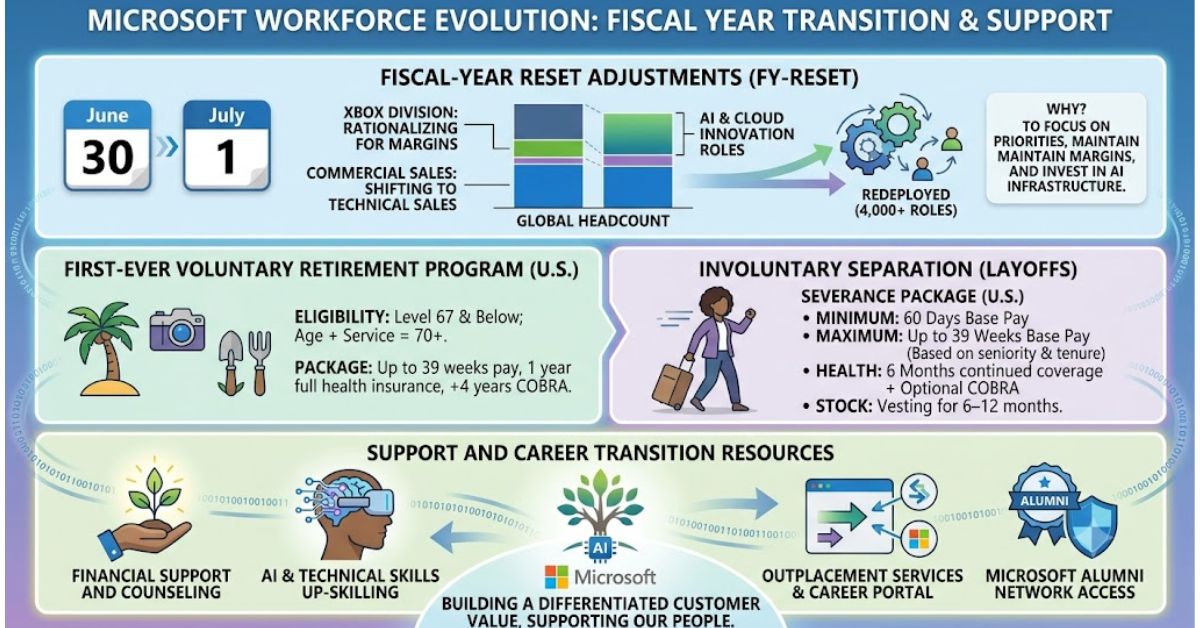
The July announcement closely followed the start of Microsoft’s fiscal year, which began on July 1. Large companies often use this period to set budgets, approve hiring plans, and reorganize teams. Microsoft has also made previous workforce changes near fiscal-year boundaries. That pattern does not reduce the human impact, but it helps explain why the July 6 decision arrived so early in the new reporting period.
The layoffs at Microsoft also followed a voluntary buyout program announced in April 2026. Reliable reporting indicated that roughly 8,750 to 9,000 U.S. employees were eligible, not that 5,500 workers had definitely accepted packages. The offer targeted qualifying employees whose age and years of service met a set threshold. Because Microsoft did not publicly confirm a final acceptance total, publishers should avoid presenting an unverified number as settled fact.
Microsoft said it redeployed more than 4,000 employees into new internal roles during the previous year, including about 500 during the month of the announcement. Internal redeployment can reduce the number of people who leave the company, especially when their skills match growth areas such as cloud services, security, data infrastructure, or AI. Still, redeployment does not guarantee that every affected worker will find a suitable position.
Employees affected by the layoffs at Microsoft should treat internal applications and external job searches as parallel tracks. Waiting only for a company transfer may reduce available options. Workers can protect themselves by documenting achievements, requesting clear separation terms, and reviewing benefit deadlines. They should also avoid sharing confidential company information while building portfolios or explaining their work to recruiters.
A useful fact-check checklist is:
- Confirm whether a number describes eligibility, offers, or accepted packages.
- Separate immediate layoffs from cuts planned across the fiscal year.
- Distinguish company statements from analyst interpretations.
- Add an “as of” date when discussing games, studios, or stock performance.
- Avoid claiming AI replaced roles unless Microsoft confirms that link.
Practical next steps for affected workers include:
- Review severance, health coverage, equity, and unused leave terms.
- Apply quickly for relevant internal openings.
- Update résumés with measurable project results.
- Ask managers and colleagues for references.
- Check unemployment eligibility and local filing deadlines.
- Build an external search plan before severance periods end.
What the Restructuring Means for Xbox Games
Microsoft said no publicly announced first-party games or projects were being canceled as part of the July reductions. That statement offers some reassurance for players following titles connected to Xbox studios. It does not guarantee that every release date will remain unchanged. Deep staffing cuts can affect production speed, quality assurance, live-service support, and the amount of content a studio can deliver, even when a project remains officially active.
The studio transitions also create different levels of risk. Double Fine and Compulsion are moving toward independence, while Ninja Theory and Undead Labs are expected to continue under new ownership. Agreements are intended to support Senua and State of Decay 3, but ownership changes can still alter budgets, staffing, or release plans. Readers should rely on official game announcements rather than assuming that “not canceled” means “unaffected.”
Players and industry observers should watch for:
- Changes to announced release windows
- New publishing or distribution agreements
- Staff departures from major development teams
- Updates involving Marvel’s Blade and Arkane Lyon
- Continued support for existing live-service games
- A larger Xbox focus on established franchises
Conclusion
The layoffs at Microsoft mark a major shift in how the company is balancing workforce costs, Xbox performance, and AI investment. About 4,800 roles were eliminated on July 6, 2026, including 1,600 immediate Xbox positions. Commercial sales teams were also affected, while the gaming division began a broader restructuring that could remove 3,200 roles across fiscal 2027 and move several studios outside Microsoft.
The most important takeaway is that the cuts reflect several pressures at once. Microsoft is funding expensive AI infrastructure, responding to investor concern, simplifying Xbox, and resetting budgets for a new fiscal year. The company has redeployed thousands of workers and said no announced first-party projects were canceled because of the reductions. Even so, employees, players, and investors should expect continued change as the restructuring develops.