People searching Casetext Acquired usually want a clear answer: Thomson Reuters bought the legal technology company for $650 million in cash. The deal was announced on June 26, 2023, and officially closed on August 17, 2023. Casetext brought established legal research technology, a strong customer base, and one especially valuable product—CoCounsel, an AI legal assistant built with OpenAI’s GPT-4.
The acquisition was more than a routine software purchase. It gave Thomson Reuters a faster route into generative AI for legal work while strengthening products such as Westlaw and Practical Law. CoCounsel subsequently became part of a broader Thomson Reuters AI ecosystem, while the original standalone Casetext experience was phased out in favor of integrated tools for law firms, legal departments, and other professional users.
Casetext Acquired: Key Deal Facts
The “Casetext acquired” timeline began on June 26, 2023, when Thomson Reuters announced a definitive agreement to purchase the California-based company. The buyer agreed to pay $650 million in cash. The transaction remained subject to regulatory approvals and customary closing conditions before closing on August 17, 2023. Thomson Reuters described Casetext as an AI and machine-learning technology provider that helped legal professionals work more efficiently.
At the time, Casetext served more than 10,000 law firms and corporate legal departments. Its portfolio included legal research technology, contextual search, and CoCounsel. Thomson Reuters did not present the acquisition as a simple expansion of its research database. Instead, it emphasized Casetext’s ability to accelerate generative AI development across research, document review, drafting, contract analysis, and deposition preparation.
| Deal detail | Information |
|---|---|
| Buyer | Thomson Reuters |
| Company acquired | Casetext, Inc. |
| Announced | June 26, 2023 |
| Completed | August 17, 2023 |
| Purchase price | $650 million in cash |
| Core strategic asset | CoCounsel, powered by GPT-4 |
Source: Thomson Reuters acquisition announcements.
Why Thomson Reuters Wanted Casetext
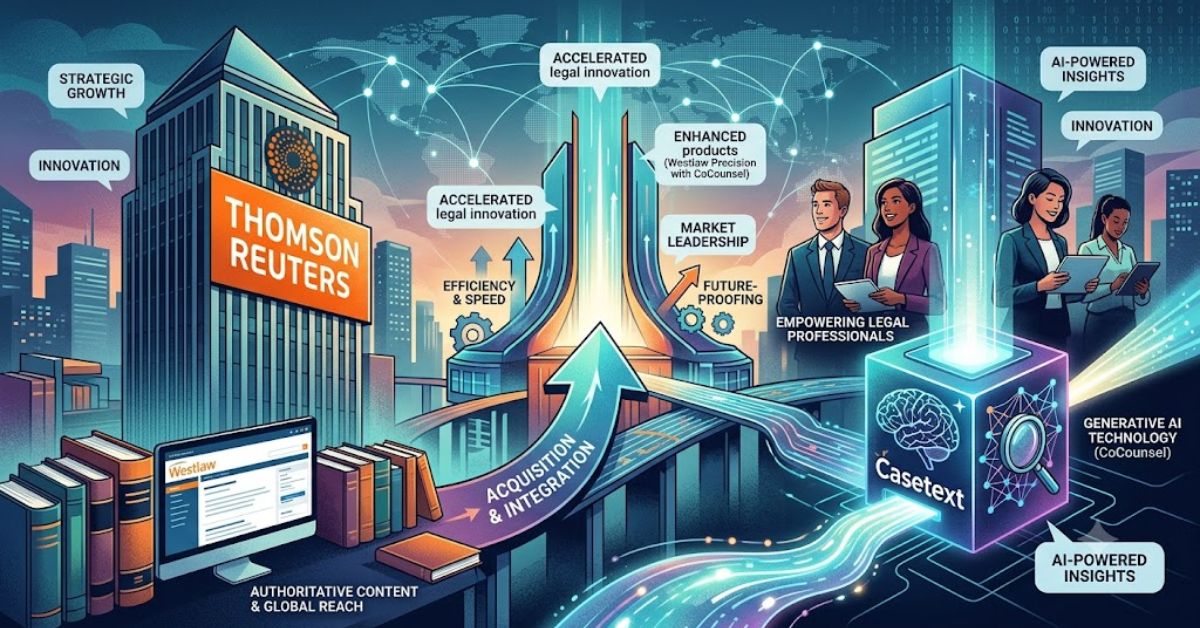
Thomson Reuters already owned major legal information platforms, including Westlaw and Practical Law. What it needed was a proven generative AI product capable of handling real legal tasks rather than merely answering general questions. Casetext offered that capability through CoCounsel, which had been developed for professional workflows and tested in legal settings. Buying Casetext reduced development time and added experienced legal AI engineers, product specialists, and domain experts.
The purchase also supported Thomson Reuters’ “build, partner, and buy” strategy. The company was developing AI internally, working with partners such as Microsoft, and acquiring specialized technology when purchasing could accelerate execution. In 2023, Thomson Reuters committed more than $100 million annually to AI, separate from acquisitions such as Casetext. Later disclosures showed broader multibillion-dollar capital capacity for technology-focused acquisitions and expansion.
The acquisition helped Thomson Reuters:
- Launch professional-grade generative AI products faster
- Combine AI workflows with trusted legal content
- Expand from search into drafting and document analysis
- Strengthen its legal technology market position
- Extend AI capabilities into additional professional fields
How CoCounsel Became the Core Asset
CoCounsel was the most important asset in the deal because it translated GPT-4 into task-based legal workflows. Instead of operating like a general chatbot, the product could review documents, prepare legal research memos, analyze contracts, summarize materials, and assist with deposition preparation. Casetext received early access to GPT-4, allowing its team to refine legal use cases before many competing legal technology companies entered the market.
For Thomson Reuters, the value came from combining CoCounsel’s workflow design with authoritative content and established distribution. AI-generated legal work creates serious accuracy, privacy, and citation risks. Integrating the assistant with Westlaw and Practical Law allowed Thomson Reuters to ground more outputs in controlled legal sources, connect answers to supporting authority, and place AI within tools attorneys already used.
| Before the acquisition | After integration |
| Casetext operated as a separate platform | CoCounsel became a Thomson Reuters product family |
| AI workflows used Casetext’s environment | Workflows connected with Westlaw and Practical Law |
| Branding centered on Casetext | Branding shifted toward CoCounsel and Westlaw |
| The main audience was legal professionals | CoCounsel expanded across professional fields |
How Casetext Technology Moved Into Westlaw
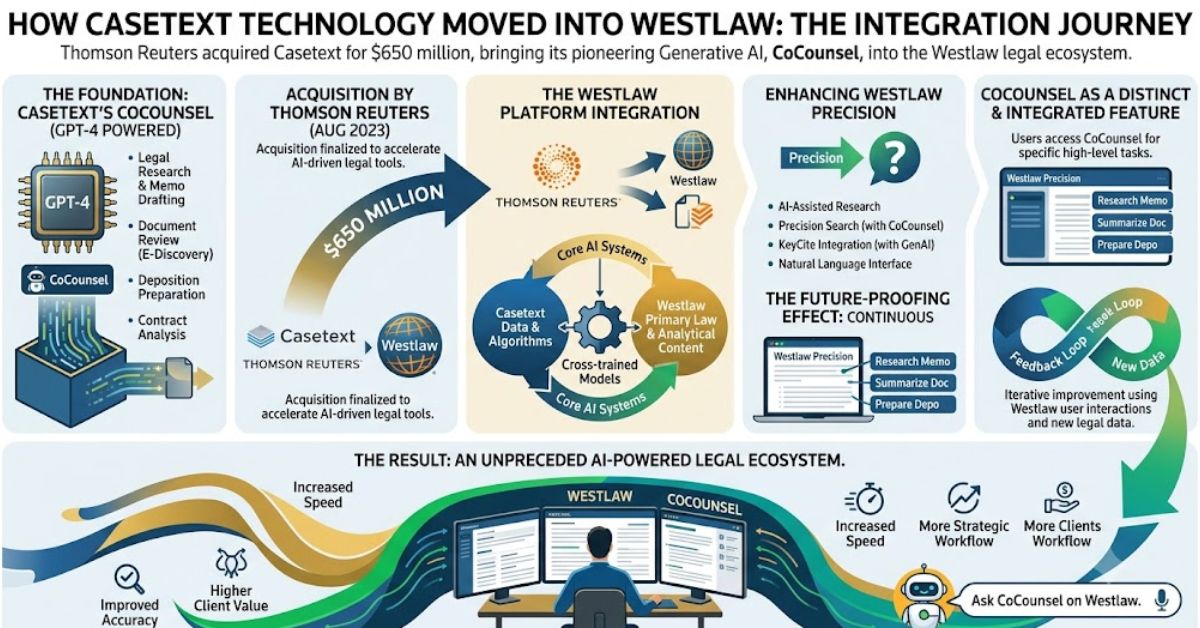
November 2023, it announced generative AI solutions building on Casetext’s work, including AI-assisted legal research and a broader CoCounsel experience. The research system used retrieval-augmented generation to focus language models on selected Westlaw content, reducing the risk of invented case names, citations, or unsupported legal propositions.
Thomson Reuters now positions CoCounsel as an integrated professional AI platform rather than a standalone Casetext feature. Its legal offerings connect research, drafting, document analysis, and verification with Westlaw and Practical Law. CoCounsel also supports Microsoft 365 and document management integrations. Casetext supplied the AI workflow layer, while Thomson Reuters contributed proprietary content, enterprise relationships, security infrastructure, and global distribution.
The integration followed a clear sequence:
- Thomson Reuters acquired Casetext and its team.
- CoCounsel was connected with Thomson Reuters content.
- AI-assisted research entered Westlaw workflows.
- CoCounsel expanded into drafting, review, and analysis.
- The product family expanded across professional markets.
What Happened to Casetext’s Legacy Products
The original Casetext platform did not remain the main destination after the acquisition. Thomson Reuters gradually centered its legal AI strategy on CoCounsel and Westlaw, while older standalone research offerings were retired. Current official product pages promote CoCounsel Legal, CoCounsel Essentials, and Westlaw packages instead of the former Casetext subscription platform. This follows a common acquisition strategy: retain the strongest technology while consolidating overlapping products and brands.
Several legal technology vendors report that the standalone Casetext service shut down on April 1, 2025. That date is widely repeated, but a current public Thomson Reuters announcement confirming the exact retirement date is difficult to locate. The reliable conclusion is that Casetext’s legacy research service was sunset and users were directed toward Thomson Reuters’ integrated ecosystem. Unsupported claims about migration prices or contracts should be avoided.
Former users needed to determine:
- Whether saved research or documents required export
- Which Westlaw or CoCounsel plan covered required features
- Whether pricing and contract terms changed
- How AI-generated citations would be verified
- Whether additional legal research tools were necessary
Conclusion
The Casetext acquired story is ultimately about Thomson Reuters purchasing speed, talent, and a market-ready AI workflow platform. The $650 million transaction brought CoCounsel into a company that already controlled major legal content and research products. This combination allowed Thomson Reuters to move faster than it could through internal development alone while giving CoCounsel access to Westlaw, Practical Law, enterprise security, and a larger customer network.
For legal professionals, the result is both useful and disruptive. CoCounsel enables faster research, drafting, and analysis, while the older Casetext platform has largely disappeared into Thomson Reuters’ ecosystem. Anyone researching “Casetext acquired” should remember the central point: Thomson Reuters was not simply buying another legal database. It was acquiring a generative AI foundation capable of reshaping how legal work is researched, reviewed, drafted, and delivered.