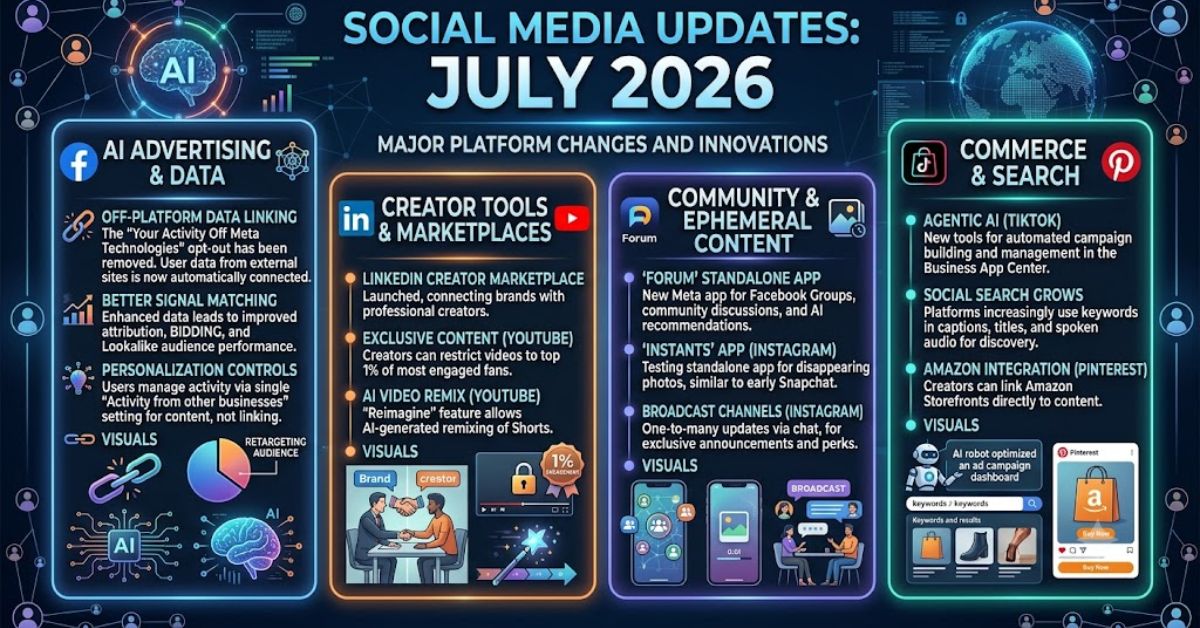
The biggest Social Media Updates for July 2026 show three clear priorities across major platforms: deeper AI integration, stronger safeguards for teenagers, and easier ways for creators and audiences to interact. Meta introduced a new image model, Instagram expanded parent alerts, WhatsApp advanced usernames and private AI tools, YouTube revived direct messaging, and TikTok demonstrated the scale of live entertainment. For marketers, these changes affect content production, reporting, privacy, and community strategy.
This roundup separates confirmed July launches from earlier announcements that were still rolling out during the month. YouTube announced its messaging expansion on June 10, and Meta published the Instagram Graph API changes on April 22, although both remained relevant to July workflows. That distinction matters because a beta, phased rollout, or earlier release may reach only part of the U.S. audience. Availability can differ by account, region, device, and operating system.
| Platform | Feature or change | Current status | Main impact |
|---|---|---|---|
| Meta AI | Muse Image | Rolling out | Faster AI image creation |
| AI account-reference removal | Removed July 10 | Greater focus on consent | |
| Teen distress alerts | Live in four markets | Stronger parental supervision | |
| Usernames and Side Chat | Phased or limited | More privacy and AI access | |
| YouTube | In-app messaging | Expanding to adults | Easier private video sharing |
| TikTok | Madonna LIVE record | Confirmed | Stronger livestream potential |
| Instagram API | Partnership and metrics tools | Available through approved integrations | Better campaign management |
Meta and Instagram Put AI at the Center
Meta launched Muse Image on July 7 as the first image-generation model from Meta Superintelligence Labs. It works inside Meta AI and can create visuals from text, combine multiple reference photos, edit marked areas, render readable text, and support more than 30 AI-powered Instagram Story effects. Meta also plans wider placement across Facebook, Messenger, WhatsApp, and advertising tools, making generative image creation a central part of its social ecosystem.
The launch also exposed a serious consent problem. Meta initially allowed people to reference public Instagram accounts when generating images, a capability many users described as an AI remix feature. After criticism from users, privacy advocates, and creative-industry groups, Meta removed the function on July 10, three days after launch. The reversal shows that powerful creation tools can create brand risk when platforms treat public images as reusable inputs without clear, active permission.
Muse Image introduces several practical capabilities:
- Text-to-image creation inside Meta AI
- Editing through sketches and annotations
- Multiple-photo blending
- More than 30 Instagram Story effects
- Readable text inside generated graphics
- Planned integration with Meta advertising tools
The AI remix removal is equally important. Brands should never assume that a technically available image is safe to manipulate. They should obtain permission before using a person’s appearance, creative work, product photography, or branded assets as AI inputs.
Instagram Strengthens Teen Safety Tools

Instagram’s enhanced parental controls are more proactive. Parents using supervision tools in the United States, United Kingdom, Australia, and Canada can now receive an alert when a teenager’s conversation with Meta AI suggests possible suicide or self-harm risk. Meta says an automated system flags concerning chats, but a human reviewer checks them before an alert is sent. The company also provides parents with expert resources for approaching the conversation safely and constructively.
This is an important safety step, but it is not a perfect detection system or a substitute for professional support. Meta acknowledges that cautious alerts may sometimes produce false positives. For brands and creators, the practical lesson is broader: youth safety now influences product design, moderation, content settings, and public trust. Campaigns aimed at teens should avoid manipulative engagement tactics, review sensitive creative carefully, and expect platforms to add stricter age-based controls.
Teen-focused campaign checklist:
- Confirm that content is appropriate for the intended age group.
- Avoid using fear, shame, or emotional pressure to increase engagement.
- Review language related to body image, mental health, and relationships.
- Create a process for escalating sensitive comments or messages.
- Check whether targeting settings exclude unintended age groups.
- Keep human moderators involved in sensitive campaigns.
WhatsApp Adds Usernames and Contextual AI Tools
WhatsApp’s July changes focus on identity, privacy, and AI assistance. Username reservations opened in phases, allowing users to secure a custom handle before broader username-based messaging. Some users can now communicate without immediately exposing a phone number, although availability remains uneven. WhatsApp is also testing Side Chat, a private Meta AI panel that can use the context of an active conversation without placing the user’s prompt or the AI response inside the main thread.
The passkey integration claim needs careful wording. WhatsApp supports passkeys for account verification, but its official companion-device instructions still use QR codes or phone-number codes. Therefore, marketers should describe passkeys as an added security layer, not as a complete worldwide replacement for QR linking. Feature availability can vary by device, operating system, account, and region, and beta reports should not be treated as confirmed global launches.
| WhatsApp feature | What it does | Availability | Important limitation |
| Usernames | Lets people connect without immediately sharing a phone number | Gradual rollout | Not available to every account |
| Username key | Adds an optional code before new contacts can message | Rolling out with usernames | Must be shared with the contact |
| Side Chat | Opens a private Meta AI panel beside a conversation | Limited testing | Not yet widely available |
| Passkeys | Uses device security for account verification | Supported on compatible devices | Does not universally replace QR linking |
| QR linking | Connects companion devices | Widely supported | Requires access to the primary phone |
| Phone-number linking | Provides an alternative to scanning a QR code | Supported for eligible devices | Still requires approval from the primary device |
For businesses, usernames could make WhatsApp easier to promote publicly. A memorable handle is simpler to place in ads, packaging, event displays, and creator profiles than a personal phone number. Businesses should still verify that the feature is available before publishing a username in permanent marketing materials.
YouTube Messaging Returns as TikTok Expands LIVE
YouTube is expanding in-app video sharing and messaging to adults in the United States and other markets. Users aged 18 or older can use a messaging icon to invite people, share videos, Shorts, and livestreams, and react within the YouTube app. The feature revives a form of private messaging that YouTube retired in 2019, but the new version emphasizes invitation-based conversations and applies YouTube’s Community Guidelines to shared content and messages.
TikTok showed why live programming remains valuable. Its July 2 iHeartRadio and TikTok LIVE event with Madonna attracted more than 2.1 million unique viewers, becoming the platform’s biggest standalone artist broadcast. TikTok also reported more than 5.75 million likes and 139,000 comments. The result suggests that creators and brands can use livestreams as interactive launches, combining interviews, polls, fan questions, exclusive previews, and real-time participation rather than treating LIVE as a simple broadcast.
The two platforms are solving different engagement problems:
- YouTube messaging helps viewers privately share and discuss content.
- TikTok LIVE creates a shared event for a large audience.
- YouTube can extend the life of tutorials, Shorts, and recommendations.
- TikTok can create urgency around launches, premieres, and announcements.
- Both features keep more audience activity inside the platform.
A product creator, for example, could premiere a demonstration through TikTok LIVE and use YouTube’s messaging feature to encourage viewers to share a longer tutorial with friends afterward.
Instagram Graph API Improves Creator Campaigns
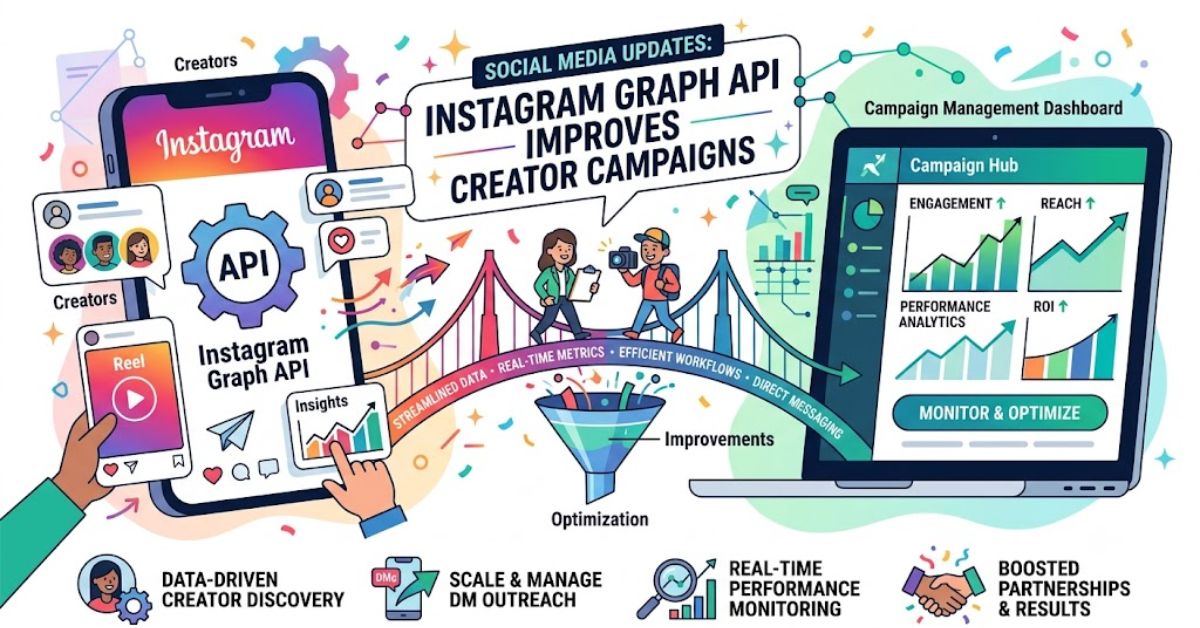
Meta’s Instagram Graph API changes are especially useful for agencies, social media managers, and creator-marketing platforms. Third-party publishing tools can add a paid partnership disclosure when an organic sponsored post is published, removing a manual step inside Instagram. The collaboration updates also improve access to collaborative posts and Reels, including engagement data such as likes, comments, reposts, saves, shares, views, and other performance signals available through approved integrations.
Reporting is becoming more complete as well. Meta introduced aggregated metrics that can combine performance across an Instagram post, its cross-posted Facebook version, and boosted variations. This reduces the risk of judging one creative from fragmented dashboards or double-counting related placements. The improvement does not remove the need for clear attribution rules, but it gives approved third-party tools a better foundation for measuring creator campaigns, comparing organic and paid results, and preparing client reports.
The API improvements can support several common workflows:
- Publish sponsored content with the partnership label already attached.
- Access approved collaborative posts through third-party tools.
- Review engagement on creator collaborations.
- Compare organic, cross-posted, and boosted performance.
- Reduce manual reporting work.
- Maintain more consistent disclosure practices.
These tools do not give unrestricted access to every Instagram account. Businesses still need appropriate account permissions, professional account types, approved integrations, and compliant authentication.
What Marketers and Creators Should Do Next
The practical response to these Social Media Updates is not to chase every feature immediately. Start by identifying which changes affect your audience, workflow, or measurement. A creator may benefit from YouTube messaging and WhatsApp usernames, while an agency may gain more from Instagram API reporting. A brand using AI images should focus on disclosure, consent, and human review. Test limited releases with a small audience before making them part of a core campaign.
Use a simple monthly review process. First, confirm whether the feature is fully launched, region-limited, or in beta. Second, document privacy and safety risks. Third, update content templates, approval steps, and reporting definitions. Fourth, run one controlled experiment with a clear success metric. Finally, record what changed and what did not. This approach helps teams benefit from platform innovation without rebuilding their strategy around tools that may be delayed, restricted, or removed.
Follow these steps:
- Verify the feature through an official platform source.
- Check whether it is available in your target U.S. market.
- Review privacy, copyright, consent, and youth-safety risks.
- Define one business goal for the test.
- Select a measurable success metric.
- Test with a limited audience or campaign budget.
- Compare the result with your existing workflow.
- Document whether the feature should be adopted, monitored, or rejected.
| Priority | Recommended action | Suggested metric |
| AI-generated content | Add human review and consent checks | Revision or rejection rate |
| Teen safety | Review creative and targeting standards | Moderation incidents |
| Private messaging | Test shareable educational content | Shares and conversations |
| Creator partnerships | Automate labels and reporting | Campaign processing time |
| Cross-platform reporting | Create one metric definition | Deduplicated engagement |
| Livestreaming | Build interactive segments | Unique viewers and comments |
| Beta features | Run small controlled tests | Adoption and completion rate |
Conclusion
The major Social Media Updates for July 2026 show platforms moving toward AI-assisted creation, private interaction, stronger teen protections, and better creator-campaign measurement. Meta’s Muse Image expands visual production but also highlights consent risks. Instagram’s parent alerts raise the safety standard. WhatsApp is developing usernames and contextual AI support. YouTube is bringing conversations back into the viewing experience, while TikTok continues to prove the reach of interactive livestreams.
For marketers and creators, the best strategy is cautious adoption. Verify availability, protect user privacy, disclose sponsored relationships, review AI-generated content, and measure results across connected placements. These Social Media Updates create useful opportunities, but several features remain phased, limited, or subject to change. Teams that combine experimentation with clear governance will be better prepared to use new tools without sacrificing trust, accuracy, or long-term brand credibility.