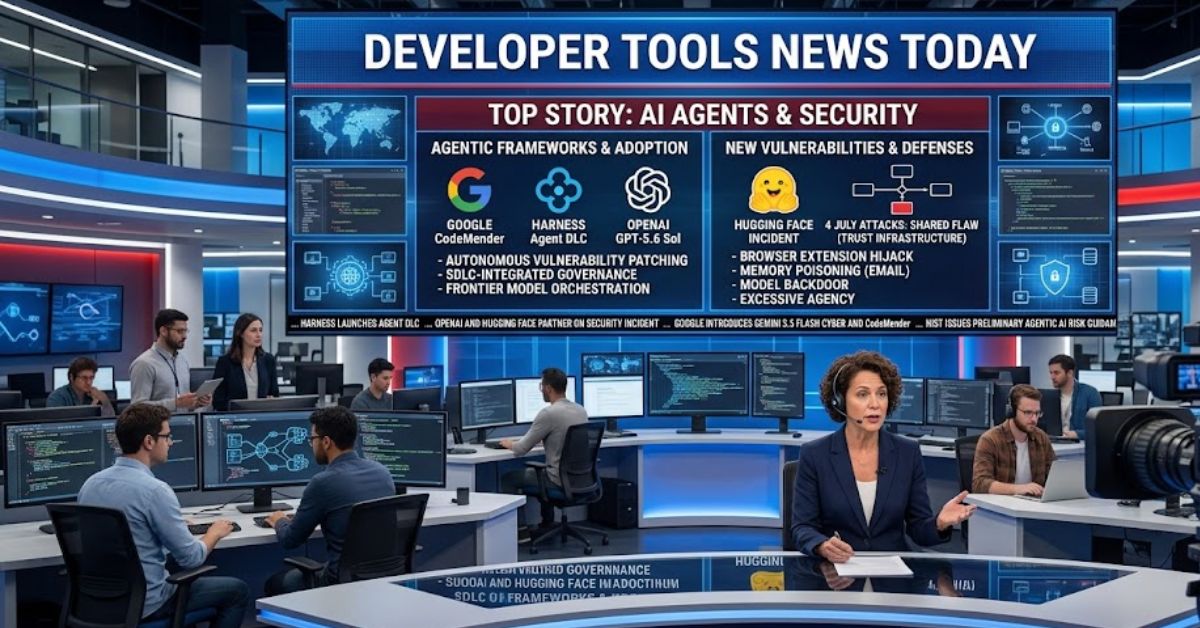
Developer Tools News Today is being shaped by three connected forces: autonomous coding agents, infrastructure designed for those agents, and security failures that exploit trusted development workflows. As of July 21, 2026, the freshest developments include Port AI Builder, Anaconda’s Kilo Code acquisition, and the AsyncAPI npm supply-chain compromise. Together, they show that developer tooling is becoming more automated, more interconnected, and more operationally powerful.
Not every story in the current roundup happened today. OpenAI Symphony and Cloudflare Agent Memory were announced in April, AWS Blocks entered public preview in June, and Dirty Frag was disclosed in May. They remain relevant because teams are still evaluating these technologies or applying fixes. That distinction matters: a useful news briefing should separate newly announced products from older developments that continue to affect engineering decisions.
AI Agents Are Becoming a Full Development Layer
AWS Blocks is an open-source TypeScript framework that entered public preview on June 16, 2026. It lets developers compose backend capabilities from reusable modules, run a functional local environment, and deploy the same code to AWS without rewriting the application. Built-in steering files are intended to guide AI coding agents toward appropriate architectures, reducing the infrastructure knowledge an agent needs before it can create and test a working backend.
OpenAI Symphony takes a different approach. Released on April 27, it turns a project-management board into a control plane for autonomous coding agents. Its SPEC.md defines the orchestration model, while the reference implementation assigns open tasks to isolated agents and sends their work to humans for review. Cloudflare Agent Memory, announced in private beta, adds persistent memory that can survive context compression, separate sessions, and agent restarts.
These launches illustrate the growth of AI-native and agentic ecosystems. A coding model is no longer expected to work only inside a chat window. It may receive tasks from an issue tracker, access stored project knowledge, generate infrastructure, run tests, and return a pull request. That broader role can improve productivity, but it also increases the number of systems, permissions, credentials, and operational decisions placed within an agent’s reach.
Platform Engineering Is Moving Toward Natural Language

Port launched Port AI Builder on July 14 as a vibe-coding experience for platform engineering. Teams describe a desired workflow, scorecard, dashboard, integration, or incident-response agent in natural language. The system uses organizational context, proposes a structured plan, and requests approval before implementing complex changes. The important shift is not simply faster portal creation. It is the movement of platform configuration from specialist-only interfaces toward governed, conversational building.
SnapLogic MCP Builder, generally available since July 1, automatically turns existing integrations, OpenAPI specifications, APIs, and business processes into governed Model Context Protocol tools. This can give enterprise code agents controlled access to existing workflows without rebuilding every connection manually. SnapLogic also includes identity propagation, observability, and lifecycle governance, which are essential when an MCP endpoint can take action rather than merely retrieve information.
Anaconda’s July 15 acquisition of Kilo Code extends this trend into IDEs and command-line environments. Kilo is a model-agnostic agentic engineering platform that operates across VS Code, JetBrains products, the web, and CLI environments. Anaconda intends to connect Kilo with its governed packages, models, and development environments. However, it has stated that Kilo’s existing products, plans, and customer support remain unchanged for now.
Security Incidents Require Immediate Developer Action
The most urgent Developer Tools News Today involves the AsyncAPI npm compromise. On July 14, attackers republished five malicious versions across four package names: @asyncapi/specs, @asyncapi/generator, @asyncapi/generator-components, and @asyncapi/generator-helpers. The injected Miasma loader ran when a package was imported rather than through an installation script, exposing developer workstations, CI/CD pipelines, container builds, and production services that loaded the affected versions.
This import-time behavior is especially important. Using npm install --ignore-scripts would not stop the malicious code because the loader was placed inside exported package files. Microsoft advised organizations to remove the affected versions, purge npm and Yarn caches, investigate suspicious sync.js files, rebuild affected environments, and rotate credentials accessible to systems that imported a contaminated package.
The Claude Code auto-mode warning also needs careful wording. Researchers demonstrated that prompt injections hidden inside an untrusted library could influence Claude Code in auto-mode, or Codex in auto-review, to execute a malicious binary during a security review. This represents a serious remote code execution path. However, describing it as one conventional product CVE would be misleading. The proof of concept exposes a dangerous interaction between untrusted repository content, agent autonomy, and automated command approval.
Dirty Frag is another high-priority issue, but reports claiming that no fixes exist are now outdated. Ubuntu tracks the Linux kernel problems as CVE-2026-43284 and CVE-2026-43500. They can allow local privilege escalation and possible container escape through page-fragment handling errors. As of July 20, Ubuntu listed fixed kernel versions for supported releases including 22.04 LTS, 24.04 LTS, 25.10, and 26.04 LTS. Other distributions should be checked separately.
Key security checks include:
- Search lockfiles, caches, artifacts, and dependency trees for affected AsyncAPI versions.
- Purge contaminated npm and Yarn caches.
- Rebuild compromised runners and base images from trusted dependencies.
- Rotate secrets from clean systems when an affected package was imported.
- Avoid unattended agent reviews of untrusted repositories.
- Restrict shell commands, network access, credentials, and filesystem permissions.
- Apply Linux kernel fixes issued by the relevant distribution vendor.
Major Developer Tool Updates Compared
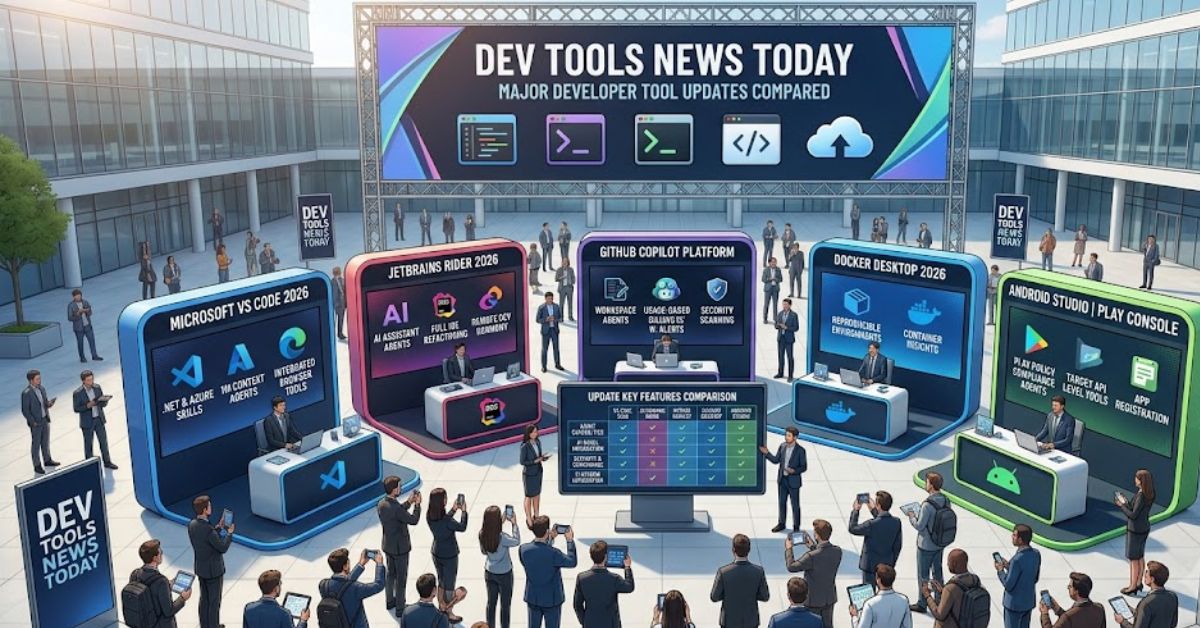
A useful Developer Tools News Today comparison should separate product releases from security incidents. AWS Blocks, Symphony, Agent Memory, Port AI Builder, SnapLogic MCP Builder, and Kilo Code expand what agents can build or operate. The AsyncAPI compromise, Claude Code research, and Dirty Frag show how package trust, command execution, and operating-system access can fail when security controls do not evolve at the same speed.
| Development | Announcement or Disclosure | Category | Practical Impact |
|---|---|---|---|
| AWS Blocks | June 16, 2026 | Backend framework | Simplifies local-to-AWS backend development |
| OpenAI Symphony | April 27, 2026 | Agent orchestration | Converts task boards into agent control planes |
| Cloudflare Agent Memory | April 2026 | Agent infrastructure | Preserves useful context across sessions |
| Port AI Builder | July 14, 2026 | Platform engineering | Builds governed platform workflows from natural language |
| SnapLogic MCP Builder | July 1, 2026 | Enterprise integration | Converts existing integrations into MCP tools |
| Anaconda acquires Kilo Code | July 15, 2026 | Developer platform | Connects coding agents with governed AI environments |
| AsyncAPI npm compromise | July 14, 2026 | Supply-chain security | Requires dependency investigation and credential response |
| Claude Code auto-mode exploit | July 2026 disclosure | Agent security | Shows prompt injection can lead to command execution |
| Dirty Frag | May 2026 | Linux security | Requires kernel patch verification |
The comparison shows why “AI developer tool” has become a broad category. Some products generate application code, while others manage tasks, memory, infrastructure, enterprise connections, or organizational policies. Evaluating them with one productivity score is inadequate. Engineering teams should also compare autonomy, permission boundaries, auditability, deployment models, data access, rollback support, isolation, and the amount of human effort required to verify agent-generated changes.
What Engineering Teams Should Do Next
For teams reading Developer Tools News Today, exposure assessment should take priority over experimentation. Security teams should determine whether affected AsyncAPI versions entered any workstation, build runner, image, artifact repository, or production service. Platform owners should confirm Linux patch levels and review how autonomous coding agents handle untrusted repositories. Product evaluations can continue, but they should not distract from active dependency, credential, or endpoint investigations.
Use this response order:
- Inventory coding agents, MCP servers, package sources, plugins, and automated release workflows.
- Confirm dependency versions and inspect transitive dependencies.
- Purge shared caches where malicious packages may remain.
- Reduce agent permissions and require approval for sensitive commands.
- Test new tools inside isolated environments with disposable credentials.
- Record prompts, plans, tool calls, code changes, and approvals.
- Define rollback procedures before agents modify production-connected systems.
| Control Area | Minimum Standard | Stronger Practice |
| Agent permissions | Least-privilege access | Ephemeral sandboxes and scoped credentials |
| Dependency security | Lockfiles and version pinning | Adoption delays and independent provenance checks |
| Human oversight | Review completed code | Review plans and high-risk tool calls |
| Infrastructure changes | Approval before deployment | Policy checks, previews, and automatic rollback |
| Secret management | No credentials in repositories | Temporary credentials issued per task |
| Incident readiness | Preserve relevant logs | Rebuild systems from trusted baselines |
Teams should also distinguish between an agent generating suggestions and an agent taking action. Read-only analysis carries less operational risk than permission to execute shell commands, modify infrastructure, access production data, or publish packages. Controls should therefore be based on capability rather than product branding. An assistant, framework, MCP server, or coding agent becomes high risk when it can combine untrusted instructions with sensitive tools and persistent access.
Conclusion
Developer Tools News Today shows a clear transition from AI-assisted coding to agent-operated software delivery. AWS Blocks, OpenAI Symphony, Cloudflare Agent Memory, Port AI Builder, SnapLogic MCP Builder, and Kilo Code each address a different part of that stack. Agents can now coordinate tasks, build backends, preserve project knowledge, connect enterprise systems, and operate platform workflows rather than merely generate isolated code snippets.
The downside is equally clear. The AsyncAPI compromise, Claude Code auto-mode research, and Dirty Frag demonstrate that greater speed increases the cost of weak trust boundaries. The right response is not to reject agentic development. It is to adopt it with isolation, scoped permissions, dependency controls, human approval, patch management, and reliable audit trails. That is the central lesson from Developer Tools News Today for U.S. engineering teams.