Physical Intelligence is the ability of a machine, material, or biological system to interact effectively with the physical world. In robotics, it describes artificial intelligence that helps machines understand objects, movement, force, space, and changing conditions. Instead of producing only words or images, a physically intelligent system must turn information into safe, useful action. It may fold fabric, move a container, open a door, or adjust its grip when an object begins to slip.
The term also refers to Physical Intelligence Inc., a San Francisco robotics startup commonly represented by the symbol π. The company is developing robot foundation models designed to control many types of hardware and perform many tasks. Its broader goal is to replace narrow, task-specific robot programming with adaptable models that learn across robots, environments, and demonstrations. That ambition has made the company an important name in the growing physical AI market.
What Is Physical Intelligence?
In artificial intelligence, physical intelligence means the capacity to perceive a real environment, understand what is happening, choose an appropriate action, and control a physical system. It combines computer vision, language understanding, spatial reasoning, motion planning, and feedback control. A robot using this approach does not merely identify a coffee mug. It must estimate the mug’s position, approach it safely, apply the right amount of pressure, and react if the mug moves.
The phrase has a broader scientific meaning as well. Researchers use it to describe how bodies, structures, and materials solve physical problems through their design. A flexible foot can absorb an impact without calculating every force. A soft material may bend when heated or change behavior under pressure. In these cases, part of the “intelligence” exists in the physical structure rather than in a centralized digital controller.
A practical definition includes four abilities:
- Perceiving objects, people, surfaces, and movement
- Reasoning about space, force, friction, and task goals
- Acting through motors, joints, grippers, or responsive materials
- Adapting when the environment differs from training
How Physical AI Differs From Generative AI
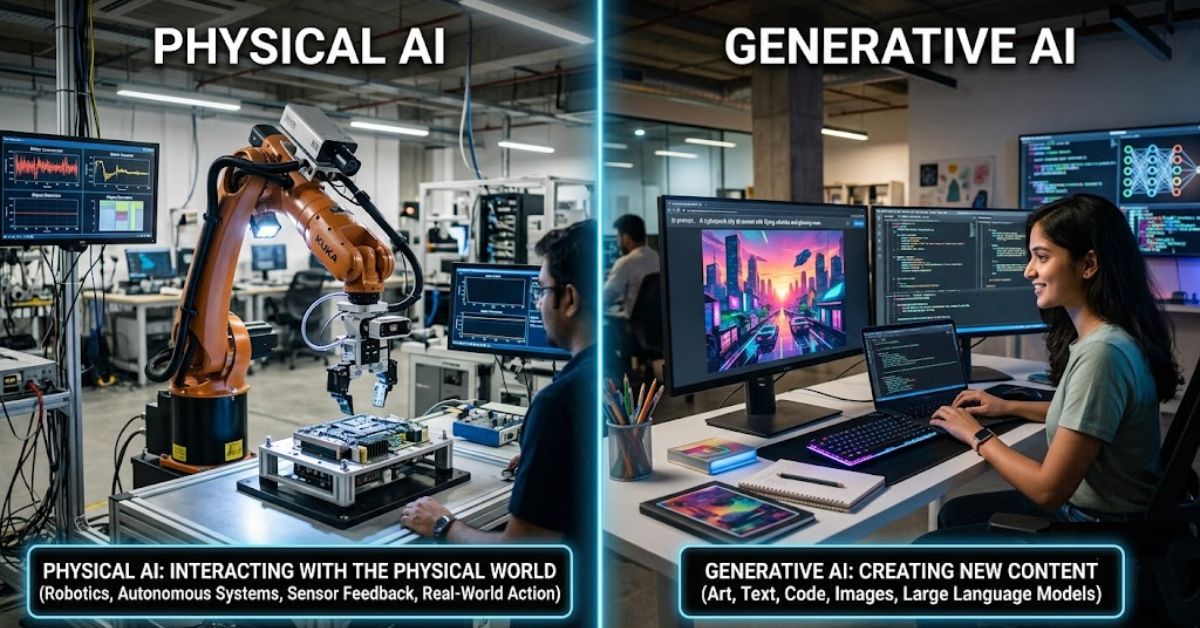
Generative AI and physical AI can use related machine-learning techniques, but their outputs and risks differ. A generative model normally produces digital content, such as text, software code, audio, or images. Physical AI controls an embodied system. Its output may be a sequence of motor commands that moves a robot arm, balances a mobile robot, or manipulates a fragile object in a changing environment.
Errors also carry different consequences. An inaccurate chatbot answer can mislead a reader, but an incorrect robot action can damage equipment or injure someone. Physical systems must continuously process camera images, joint positions, touch information, and other sensor data. They also operate under strict timing limits. A useful robot cannot pause for several minutes before correcting a slipping glass or avoiding a person walking into its path.
| Feature | Generative AI | Physical AI |
|---|---|---|
| Primary output | Text, images, code, audio, or video | Movement and physical task execution |
| Common architecture | Large language or diffusion models | Vision-language-action models and control policies |
| Training sources | Text and digital media | Images, sensor streams, demonstrations, and robot trajectories |
| Main environment | Digital interfaces | Homes, factories, farms, hospitals, and public spaces |
| Major concern | Inaccurate or fabricated content | Safety, timing, force, collision, and hardware reliability |
How Physical Intelligence Works in Robots
Modern robot learning systems often follow a perception-reasoning-action loop. Cameras and sensors provide information about the scene. The model connects that information with a language instruction or task objective. It then predicts a useful action, observes the result, and adjusts. This feedback matters because physical environments are never perfectly predictable. Lighting changes, objects shift, fabric wrinkles, and two items with the same appearance may have different weights.
Vision-language-action models, often shortened to VLA models, bring these capabilities into one architecture. A VLA model can associate visual observations and natural-language commands with robot actions. Physical Intelligence’s original π0 research used a pretrained vision-language model with a flow-matching architecture to generate continuous actions. Its training combined data from multiple robots and tasks, supporting the broader goal of generalization across different embodiments.
A simplified workflow looks like this:
- A person gives the robot a task in natural language.
- Cameras and sensors capture the current environment.
- The model identifies relevant objects and spatial relationships.
- It predicts a sequence of physical actions.
- Sensors measure the outcome of each movement.
- The model corrects its behavior as conditions change.
Useful training data may include:
- Human teleoperation demonstrations
- Robot camera and joint recordings
- Successful and unsuccessful task attempts
- Data gathered from multiple robot designs
- Simulated environments and synthetic variations
- Feedback collected during real-world operation
Physical Intelligence Inc. and Its General Robot Model
Physical Intelligence was founded in 2024 by a team that includes Chelsea Finn, Sergey Levine, Karol Hausman, Brian Ichter, Lachy Groom, Quan Vuong, and Adnan Esmail. The group combines academic robotics research, machine learning experience, and company-building expertise. Its stated objective is to create learning algorithms for a model capable of controlling different robots and completing a broad range of physical tasks.
The company’s first widely documented generalist policy, π0, was introduced in October 2024. It was followed by π0.5, which focused on open-world generalization, and π*0.6, an reinforcement-learning system designed to improve through autonomous experience. The company reported that experience-based training more than doubled throughput on some precise tasks, although these systems remain research-stage technologies rather than universal consumer robot brains.
| Model | Publicly stated focus | Why it matters |
| π0 | Generalist robot policy across tasks and robots | Established the company’s foundation-model approach |
| π0.5 | Generalization to new environments | Tested whether learned skills transfer beyond training scenes |
| π*0.6 | Learning from autonomous experience | Explored how robots can improve through reinforcement learning |
Investor interest has been substantial. In November 2024, Reuters reported that the company raised $400 million from investors including Jeff Bezos, OpenAI, Thrive Capital, and Lux Capital. In March 2026, reports said the startup was discussing another raise of approximately $1 billion at a valuation above $11 billion. Because that later transaction was reported as a negotiation, it should not be presented as a completed funding round without subsequent confirmation.
Why General-Purpose Robot Intelligence Is Difficult
Robots encounter physical variation that digital systems can avoid. A towel can fold into countless shapes. A drawer may stick. A transparent object may be difficult for a camera to detect. A robot trained in one kitchen may struggle when cabinets, lighting, tools, or counter heights change. General robot intelligence must handle this variation while controlling motion with enough precision to complete the task safely.
The challenge also reflects Moravec’s paradox: activities that feel effortless to people can be extremely difficult for computers and robots. Humans learn to balance, grasp, and navigate through years of physical experience. These skills rely on touch, vision, body awareness, and fast feedback. Reproducing them requires more than language reasoning. It demands reliable perception, dexterous hardware, large physical datasets, and control systems that react in fractions of a second.
Before deployment, developers must evaluate:
- Collision avoidance around people and equipment
- Safe limits for speed, force, and joint movement
- Performance on unfamiliar objects and environments
- Recovery after failed or interrupted actions
- Human override and emergency-stop functions
- Privacy protections for camera and sensor data
- Reliability across different robot hardware
Physical Intelligence in Biology and Smart Materials
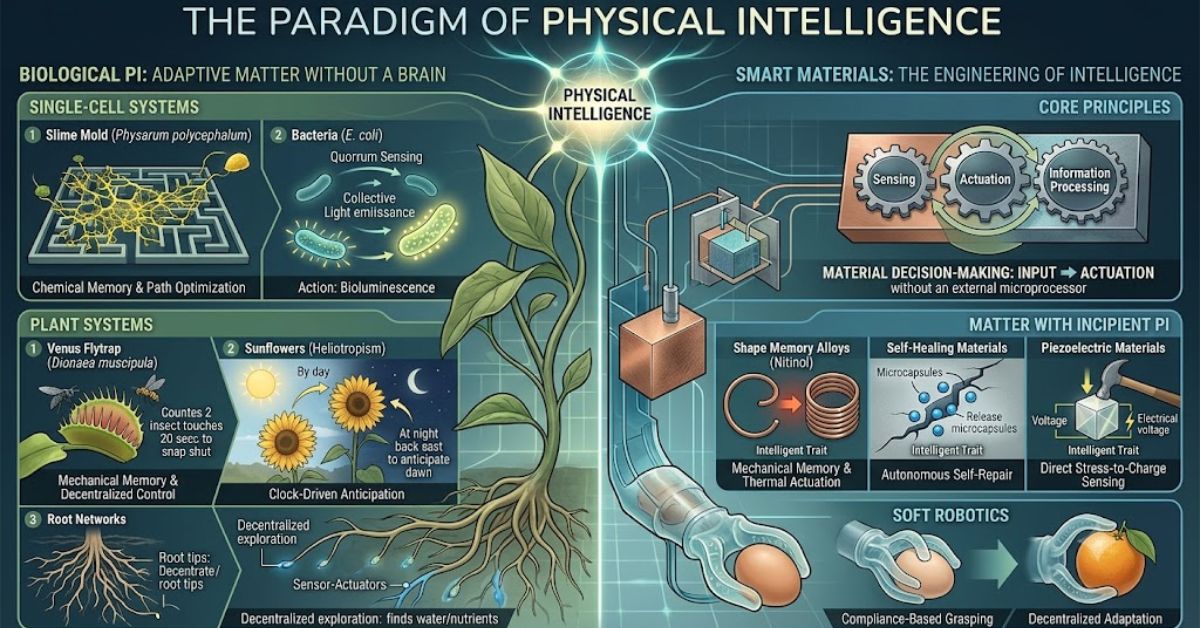
Physical intelligence does not always require a powerful processor. Biological organisms frequently use body shape, elasticity, friction, and material stiffness to reduce the amount of active computation needed for movement. A bird’s wing changes shape under airflow. A gecko’s feet exploit surface forces. Human tendons store and release energy while walking. These physical features perform part of the control task automatically.
Soft robotics applies similar principles to artificial machines. Engineers can build flexible structures that conform to irregular objects or move safely around people. Smart materials may respond to heat, light, moisture, acidity, electricity, or mechanical force. Research on material-based intelligence examines systems that sense, adapt, or self-organize through their physical properties, potentially reducing dependence on rigid motors and centralized controllers.
Examples include:
- Soft grippers that wrap around delicate produce
- Shape-memory materials that return to a programmed form
- Structures that bend in response to temperature
- Flexible robots designed for confined environments
- Surfaces that change stiffness when pressure is applied
Where Physical Intelligence Could Be Used
In homes, adaptable robots could eventually help with laundry, cleaning, food preparation, and support for older adults or people with disabilities. Unlike a conventional appliance, a general-purpose robot would need to understand varied instructions and work with objects it has not seen in exactly the same arrangement. Early research demonstrations suggest progress, but dependable household autonomy still requires stronger safety, dexterity, affordability, and long-term reliability.
Commercial uses may arrive sooner in controlled or semi-structured settings. Warehouses, factories, farms, laboratories, and recycling facilities contain repetitive physical work but also enough variation to challenge traditional automation. A foundation model that transfers skills across equipment could reduce programming time and make smaller production runs economical. Physical AI could also support inspection, disaster response, and hazardous-material handling where human exposure creates serious risk.
Potential applications include:
- Picking mixed products in warehouses
- Sorting recyclable materials
- Loading and unloading industrial equipment
- Handling crops with irregular shapes
- Inspecting infrastructure in dangerous locations
- Assisting with laboratory procedures
- Performing repetitive hospital logistics
Conclusion
Physical intelligence connects artificial reasoning with real movement. It allows machines to perceive their surroundings, understand instructions, control hardware, and adapt when the world does not match a fixed script. The field includes robot foundation models, vision-language-action systems, embodied AI, soft robotics, biological design, and responsive materials. Each area explores a different way of making physical behavior more capable and adaptable.
Physical Intelligence Inc. represents one ambitious effort to create a reusable AI brain for many robots rather than separate software for every machine and task. Its research demonstrates meaningful progress, but general-purpose robotics remains an unsolved engineering challenge. The future of physical intelligence will depend not only on larger models, but also on safer control, better hardware, diverse real-world data, and systems that earn human trust.