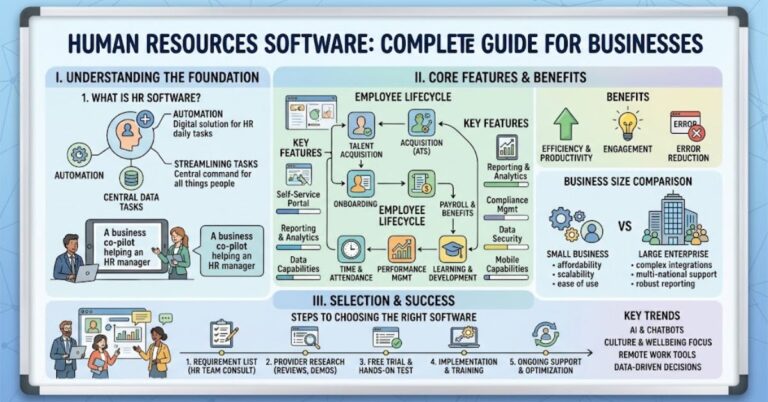
Performance Management Systems have moved far beyond the traditional annual employee review. Modern organizations need a structured way to define expectations, measure progress, provide useful feedback, develop skills, and connect individual work with company objectives. A strong system turns employee performance into an ongoing business process rather than an administrative task completed once or twice a year. SAP similarly describes performance management as consistent, measurable tracking of employee performance.
The shift toward continuous performance management is important because priorities, projects, and employee development needs can change throughout the year. Regular conversations allow managers to address problems earlier while recognizing strong performance when it happens. Current performance management approaches increasingly combine goals, check-ins, coaching, feedback, development, and formal reviews instead of treating the annual appraisal as the entire process.
What Are Performance Management Systems?
A performance management system is a structured framework used to track, evaluate, and improve employee performance while keeping individual work aligned with business goals. It typically includes goal setting, performance measurement, manager feedback, employee development, reviews, and recognition. The framework may be managed through HR software, although performance management itself is a business process rather than simply a technology product. Clear expectations and measurable outcomes are central to effective systems.
Performance management should also be separated from performance appraisal. An appraisal is usually one evaluation event, such as a quarterly or annual review. Performance management covers the entire relationship between expectations, ongoing work, coaching, progress, development, and results. This continuous approach gives employees more opportunities to understand what is expected and make adjustments before the formal review arrives. It also gives managers better context when evaluating final outcomes.
A modern system typically helps organizations:
- Set measurable employee and team goals
- Connect employee goals with business priorities
- Track progress throughout the year
- Provide real-time or frequent feedback
- Identify employee development needs
- Conduct structured performance reviews
- Recognize strong performance
- Document performance trends and decisions
How the Performance Management Cycle Works
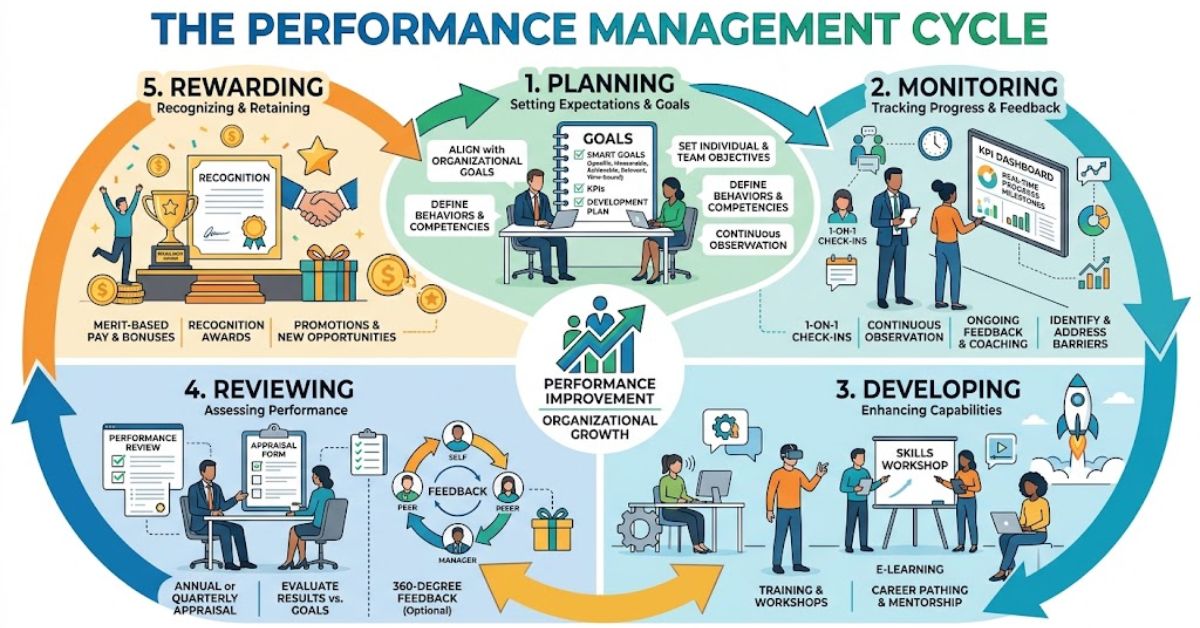
The performance management cycle is continuous rather than linear. Organizations establish goals, track progress, identify development needs, review results, and recognize achievement before beginning another cycle. Employees may revisit goals when projects or business priorities change. This prevents objectives established months earlier from becoming disconnected from current work. Continuous performance management platforms increasingly support regular goal tracking and conversations between employees and managers.
The exact process varies by company, but five stages provide a practical framework. Each stage supports the next. Planning creates clarity, tracking reveals progress, developing closes capability gaps, reviewing evaluates results, and rewarding reinforces valuable performance. Problems appear when organizations focus heavily on reviewing and rewarding while neglecting planning, coaching, or development. A well-designed cycle makes employee improvement an ongoing responsibility shared by managers and employees instead of a year-end HR exercise.
| Cycle Stage | Main Purpose | Example |
|---|---|---|
| Planning | Establish expectations and goals | Set quarterly sales or project targets |
| Tracking | Monitor progress | Review KPIs during monthly check-ins |
| Developing | Improve knowledge and skills | Assign training or coaching |
| Reviewing | Evaluate results and behaviors | Hold a quarterly performance discussion |
| Rewarding | Recognize contribution | Promotion, bonus, praise, or new responsibility |
A practical cycle can follow these steps:
- Set clear goals and performance expectations.
- Track progress using relevant metrics and regular conversations.
- Identify skill gaps and development opportunities.
- Review results using consistent criteria.
- Recognize achievement and establish the next set of goals.
Popular Performance Management Methods
Organizations do not need to use one performance management method exclusively. Many combine different frameworks depending on their culture, workforce, and business model. For example, a company might use OKRs to establish goals while also collecting 360-degree feedback for leadership development. The best approach is one that creates useful information without producing unnecessary forms, meetings, or ratings that employees and managers complete only because HR requires them.
Four methods appear frequently in modern Performance Management Systems. OKRs connect objectives with measurable key results. Management by Objectives, or MBO, evaluates performance against agreed targets. A Balanced Scorecard examines performance across several strategic dimensions rather than relying on one financial measure. Meanwhile, 360-degree feedback adds perspectives from people who regularly work with the employee instead of relying entirely on one manager’s opinion. Culture Amp currently supports goals, 360 feedback, and one-on-one performance conversations.
| Method | Best Used For | Main Strength |
| OKRs | Goal alignment | Connects measurable results with larger objectives |
| 360-Degree Feedback | Leadership and behavioral development | Collects feedback from multiple perspectives |
| Balanced Scorecard | Strategic performance | Measures several areas of organizational success |
| MBO | Target-driven roles | Links evaluation to agreed objectives |
No framework fixes poor management by itself. Goals still need to be realistic, feedback must be specific, and employees need enough resources to achieve what is expected. Companies should therefore select methods based on the decisions they need to make rather than adopting a popular framework simply because competitors use it.
Benefits of Effective Performance Management Systems
One of the biggest advantages of Performance Management Systems is clarity. Employees perform better when they know what success looks like, how their work will be measured, and how their role contributes to broader priorities. Managers also gain a consistent structure for discussing progress instead of waiting until an employee has already missed a major target. Workday highlights the value of intentionally selected performance metrics for creating clearer expectations and connecting employee work with outcomes.
Continuous feedback also turns performance management into a development tool. Managers can recognize strong work, correct problems, and identify learning opportunities while the information is still useful. Employees receive a clearer picture of where they are progressing and where additional support is required. Regular check-ins can support this model; for example, 15Five’s current platform uses recurring check-ins to surface challenges, recognize wins, and track progress toward goals and OKRs.
Potential benefits include:
- Better alignment between employee and organizational goals
- Faster identification of performance problems
- More useful manager-employee conversations
- Stronger employee development
- Greater visibility into high performers
- More consistent performance decisions
- Better succession and workforce planning
- More timely employee recognition
However, a poorly designed system can create the opposite result. Excessive ratings, vague targets, biased reviews, or too many administrative steps can reduce trust. Companies should measure whether the process actually helps employees improve rather than judging success by the percentage of review forms completed.
Performance Management Software in 2026
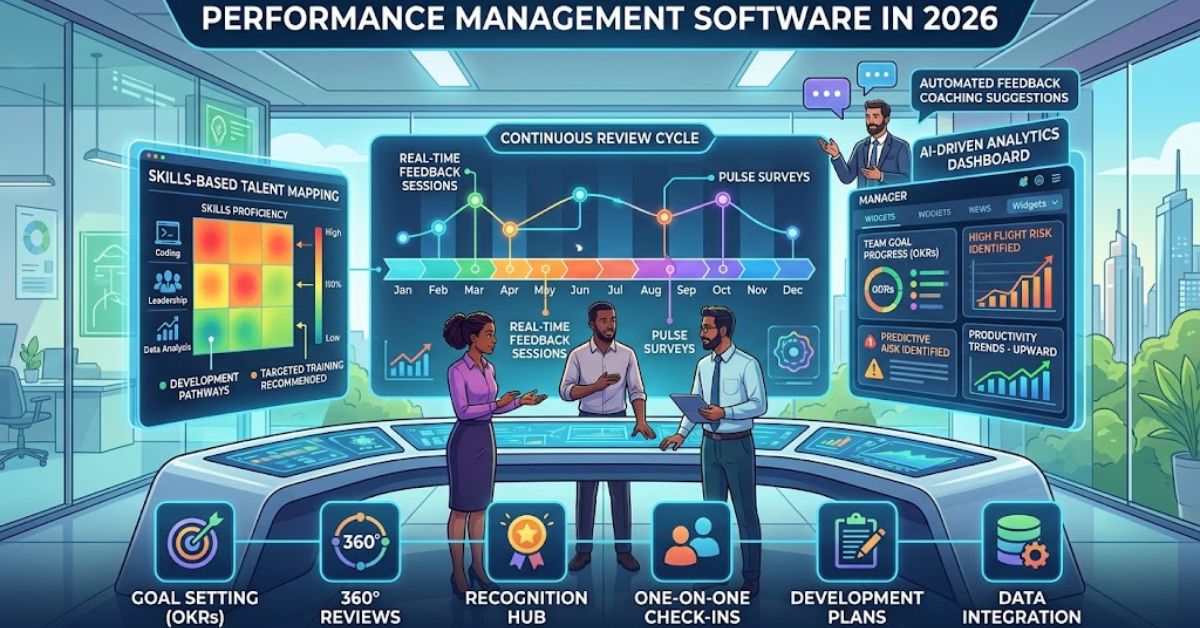
Performance management software can automate goal tracking, feedback collection, reviews, check-ins, reporting, and development workflows. The right platform depends heavily on company size and HR complexity. A smaller organization may prioritize simplicity and manager adoption, while a large enterprise may need deeper workforce analytics, integrations, permissions, and broader human capital management capabilities. Software should support the company’s performance philosophy instead of forcing employees into unnecessary processes.
Several major platforms remain relevant in 2026. Lattice connects goals with performance conversations, feedback, one-on-ones, reviews, and development workflows. Culture Amp combines goals, reviews, 360-degree feedback, and employee experience capabilities. 15Five emphasizes ongoing check-ins and performance coaching. Workday offers goal-based performance capabilities within a much broader enterprise HCM environment. Their current product materials confirm these capabilities.
| Platform | Strong Fit | Notable Focus |
| Lattice | Growing and mid-sized organizations | Goals, reviews, feedback, 1:1s, development |
| Culture Amp | Data-driven people teams | Performance plus employee engagement |
| 15Five | Teams emphasizing frequent coaching | Check-ins, goals, feedback, manager effectiveness |
| Workday HCM | Large organizations | Enterprise performance and broader HCM processes |
Choosing the most recognizable software brand is not automatically the best decision. Companies should evaluate workflows, reporting, integrations, usability, implementation requirements, security, scalability, and total cost before buying.
How to Choose and Implement a Performance Management System
Start with the business problem instead of the software demonstration. Determine whether the organization needs stronger goal alignment, more frequent feedback, better performance reviews, clearer development planning, improved reporting, or several of these outcomes. Then identify the minimum features needed to support them. This makes it easier to compare platforms objectively and prevents teams from paying for sophisticated capabilities they may never use.
Implementation matters just as much as platform selection. Managers need training on goal setting, coaching, evidence-based evaluation, and difficult performance conversations. Employees also need to understand how performance information will be used. A simple system that managers consistently use will usually produce more value than an advanced system filled with unused dashboards and incomplete reviews. The process should be monitored and improved based on employee, manager, and HR feedback.
Conclusion
Performance Management Systems work best when they create an ongoing connection between company goals and everyday employee performance. Planning, tracking, development, reviewing, and rewarding should function as one continuous cycle. Methods such as OKRs, 360-degree feedback, MBO, and the Balanced Scorecard can strengthen that cycle when they match the organization’s actual needs rather than becoming additional administrative exercises.
Technology can make the process easier, but software alone will not improve performance. Successful Performance Management Systems require clear expectations, useful metrics, capable managers, frequent communication, employee development, and fair evaluation. Organizations choosing a system in 2026 should therefore focus less on collecting features and more on building a process employees and managers can use consistently to improve both individual results and business performance.