Human Resources Software has changed the way companies manage their employees. Instead of relying on paper records, email chains, and complicated spreadsheets, businesses can keep employee information, payroll data, attendance records, hiring activities, and benefits in one centralized system. This makes everyday HR work faster while giving managers easier access to the information they need to make informed decisions.
The right system can support almost every stage of the employee journey, from recruitment and onboarding to payroll, performance management, leave requests, and eventually offboarding. However, HR platforms differ significantly in features and complexity. A five-person startup does not need the same system as a multinational company with thousands of employees, so understanding the available options is essential.
What Is Human Resources Software?
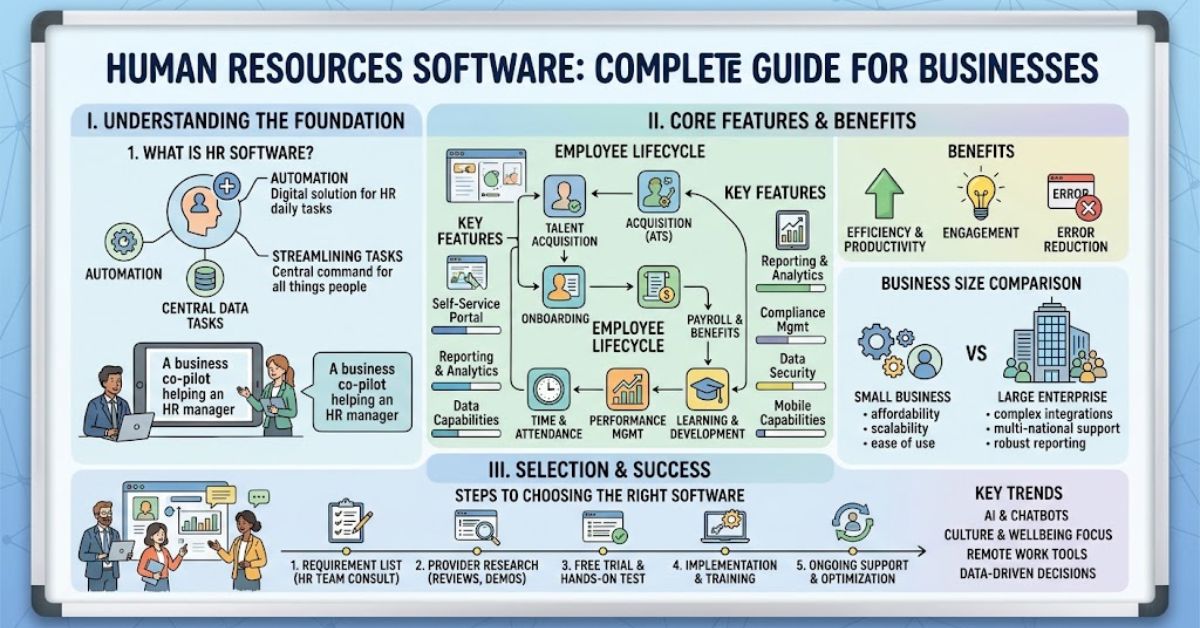
Human Resources Software is a digital platform designed to help businesses organize and manage employee-related processes. It can store employee records, calculate salaries, track working hours, manage benefits, process leave requests, and support recruitment. Instead of keeping this information across several disconnected files, HR teams can access important employee data from one secure platform.
Modern HR systems also reduce repetitive administrative work. For example, an employee can update personal information or request vacation through a self-service portal instead of sending an email to HR. Managers can approve the request inside the same system, while the software automatically updates the employee’s available leave balance and maintains a record of the transaction.
Common uses include:
- Employee record management
- Payroll processing
- Recruitment and applicant tracking
- Time and attendance management
- Benefits administration
- Performance management
- Leave and vacation tracking
- Employee onboarding
- HR reporting and analytics
Key Features of Human Resources Software
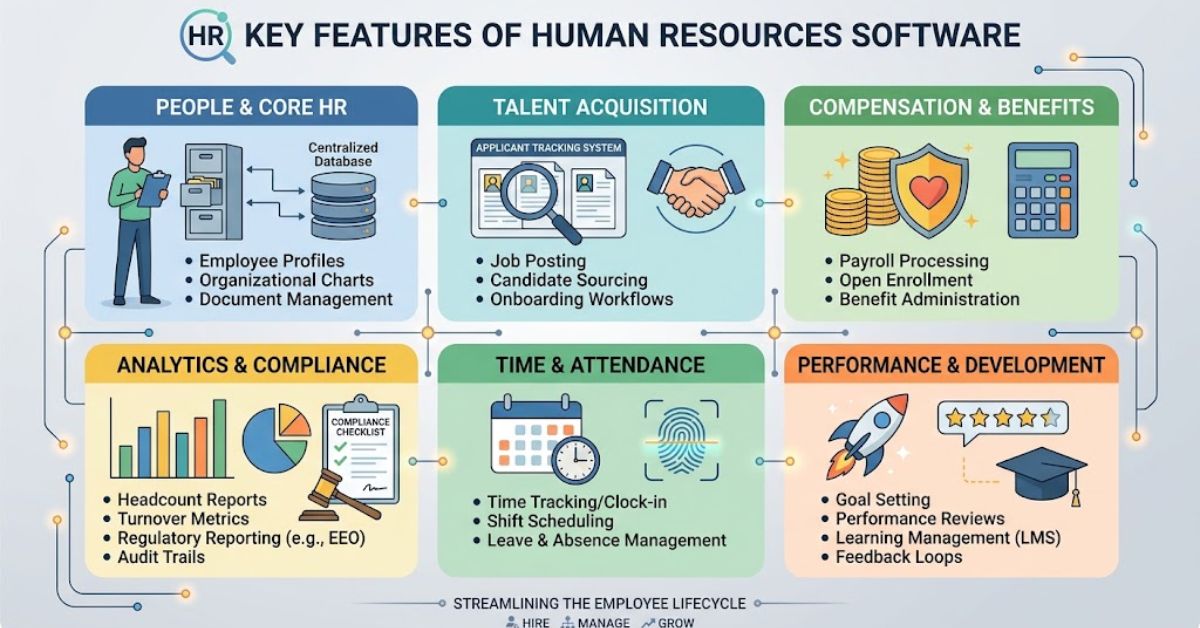
Payroll processing is one of the most valuable features of Human Resources Software. A payroll system can calculate salaries, deductions, overtime, bonuses, and applicable taxes while generating employee payslips. Automating these calculations reduces manual work and can lower the risk of payroll errors. Some platforms also integrate payroll directly with attendance records so approved working hours automatically flow into payroll calculations.
Time and attendance tools help businesses track employee working hours, breaks, shifts, absences, and overtime. Many platforms also provide an applicant tracking system, or ATS, for managing job openings and candidates. An employee self-service portal gives workers direct access to payslips, leave balances, personal details, and benefits information without requiring HR staff to handle every routine request.
A strong HR platform should typically offer:
- Payroll and compensation tools
- Time and attendance tracking
- Applicant tracking system capabilities
- Employee self-service access
- Leave management
- Onboarding workflows
- Reporting and analytics
- Role-based access controls
- Integration with accounting or productivity tools
Best Human Resources Software Options
Several global HR platforms serve different types of businesses. Rippling is known for combining HR automation with employee technology management. BambooHR focuses heavily on usability and core HR functions for small and midsize businesses. Gusto is widely associated with payroll and benefits management, while ADP Workforce Now provides broader reporting, payroll, workforce management, and talent tools for larger organizations.
Businesses operating in Pakistan may also consider platforms designed around regional requirements. FlowHCM provides HR and payroll capabilities suited to local business environments, while WebHR offers cloud-based employee management and attendance features, including options for biometric attendance integration. The best choice depends less on brand recognition and more on whether the platform fits a company’s payroll, compliance, workforce, and reporting requirements.
| HR Software | Best Suited For | Notable Focus |
|---|---|---|
| Rippling | Growing companies | HR and IT automation |
| BambooHR | Small and midsize businesses | Simple employee management |
| Gusto | Small businesses | Payroll and benefits |
| ADP Workforce Now | Larger organizations | Payroll, analytics and workforce management |
| FlowHCM | Pakistan-based businesses | Local HR and payroll management |
| WebHR | Small and growing teams | Cloud HR and attendance management |
Companies should evaluate these products based on current features, pricing, integrations, compliance capabilities, and customer support before making a purchasing decision.
HRIS vs. HRMS vs. HCM
HRIS stands for Human Resources Information System. It mainly focuses on maintaining core employee information, benefits records, attendance information, and other essential HR data. You can think of an HRIS as a centralized digital filing system that replaces many of the spreadsheets, paper files, and disconnected databases traditionally used by HR departments.
HRMS means Human Resources Management System and normally includes broader workforce management capabilities. HCM, or Human Capital Management, goes further by supporting areas such as talent development, workforce analytics, learning, succession planning, and strategic workforce decisions. These terms often overlap because software companies define their products differently, so businesses should compare actual features rather than relying solely on product labels.
| System | Primary Purpose | Typical Features | Best Fit |
| HRIS | Employee information management | Records, benefits, attendance | Small to midsize organizations |
| HRMS | Broader HR administration | HRIS tools, payroll, performance, costs | Growing businesses |
| HCM | Strategic workforce management | Analytics, learning, talent planning | Larger or global organizations |
Benefits of Using Human Resources Software
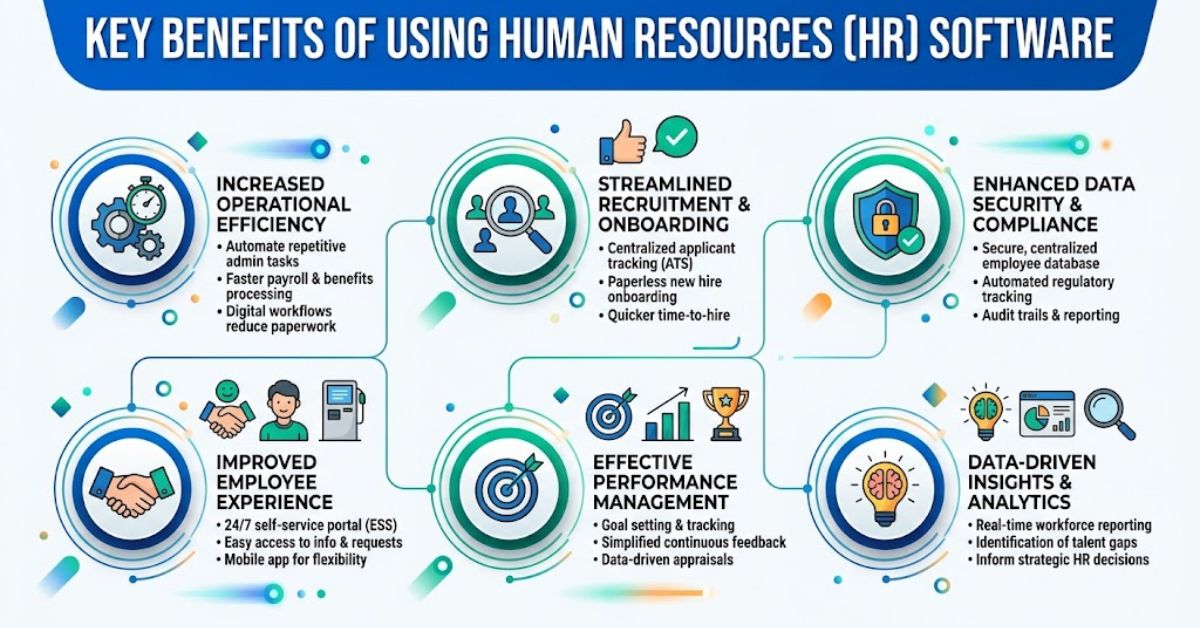
One major benefit of HR software is automation. HR professionals often spend significant time entering employee information, preparing payroll data, answering leave questions, and updating records. Automating repetitive tasks allows HR teams to spend more time on recruitment strategy, employee development, workforce planning, retention, and other activities that contribute more directly to business performance.
Centralized data can also improve accuracy and visibility. Managers can access approved information without searching through several spreadsheets or asking HR to prepare basic reports. Good systems provide controlled access so employees, managers, payroll teams, and administrators see only the information relevant to their responsibilities. Reporting tools can also help businesses identify attendance trends, turnover patterns, hiring performance, and other workforce metrics.
Potential advantages include:
- Less repetitive administrative work
- Faster payroll preparation
- Centralized employee records
- More consistent HR processes
- Better workforce reporting
- Easier employee self-service
- Improved recruitment workflows
- Better visibility into attendance and leave
Software does not automatically fix poor HR processes. If a company has unclear policies, inaccurate data, or badly designed approval workflows, digitizing those problems may simply make them happen faster. Businesses should improve weak processes before automating them.
How to Choose the Right HR Software
Start by identifying the HR problems your company actually needs to solve. A small business mainly struggling with payroll and leave management may not need an expensive enterprise HCM platform. A growing organization hiring hundreds of employees, however, may need an ATS, automated onboarding, performance management, analytics, integrations, and more advanced workforce planning capabilities.
Businesses should also evaluate ease of use, data security, integrations, customer support, scalability, and total cost. A low monthly subscription can become expensive once payroll modules, recruiting tools, implementation services, or additional users are added. Request demonstrations and test common workflows before purchasing so HR staff and employees can determine whether the system is practical.
Conclusion
Human Resources Software can simplify payroll, attendance, recruitment, employee records, leave management and many other HR activities. Platforms such as Rippling, BambooHR, Gusto, ADP Workforce Now, FlowHCM, and WebHR serve different markets, so there is no single system that is automatically best for every organization.
The most effective Human Resources Software is the one that matches your workforce size, compliance requirements, budget, existing technology, and everyday HR processes. Compare actual features carefully, test the system before committing, and prioritize usability and long-term scalability over an unnecessarily long feature list.