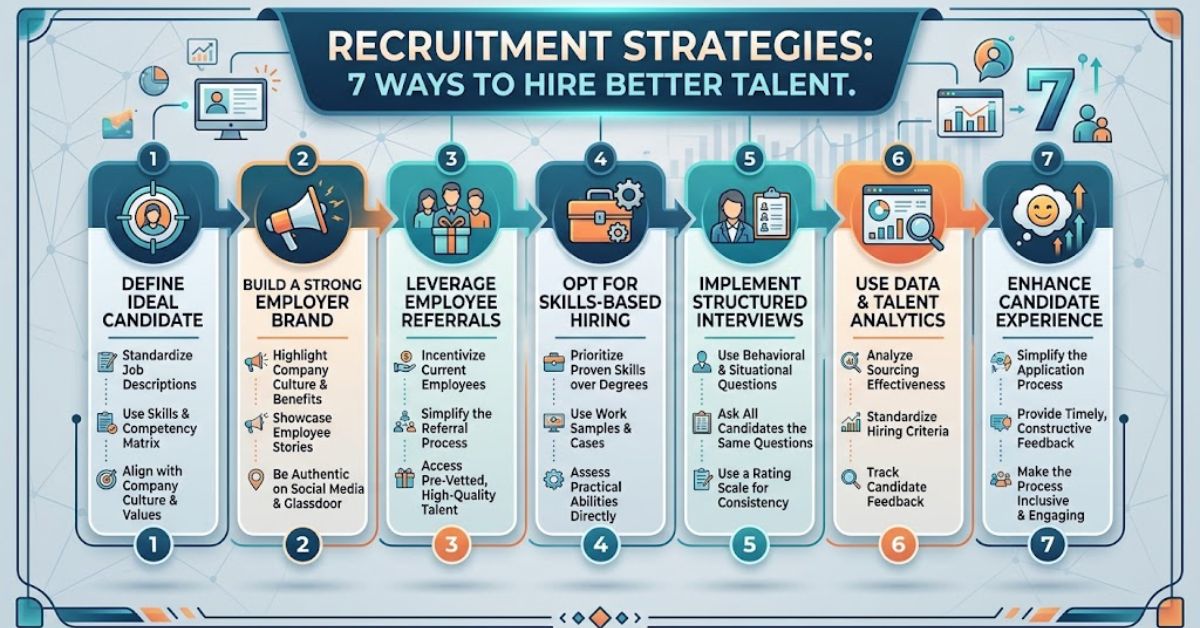
Recruitment Strategies are structured plans businesses use to find, attract, evaluate, and hire the right people for open roles. A good strategy does more than generate applications. It connects workforce needs with the right sourcing channels, employer message, screening process, and candidate experience. When those pieces work together, companies can reduce wasted hiring effort, reach stronger candidates, and make better-informed hiring decisions.
The strongest approach is not one tactic. It is a repeatable system that combines employer branding, employee referrals, clear job descriptions, social recruiting, recruiting technology, talent rediscovery, and skills-based hiring. The goal is simple: create a process that helps qualified people discover the opportunity, understand why it matters, prove they can do the work, and move through hiring without unnecessary friction.
What Are Recruitment Strategies?
At its core, a recruitment strategy answers four questions: who do you need, where will you find them, why should they choose your company, and how will you decide who is qualified? Those questions turn hiring from a reactive scramble into a business process. Indeed recommends assessing recruiting performance, forecasting hiring needs, setting goals, and monitoring metrics such as time to hire, candidate sources, offer acceptance, cost per hire, and retention.
A useful plan should also match the type of role. High-volume hourly hiring may depend on local job boards, fast screening, and mobile applications. A specialized engineering role may require targeted outreach, industry communities, referrals, and a longer evaluation process. That is why copying another company’s recruitment strategies rarely works. The channel, message, assessment method, and hiring timeline should reflect the skills, seniority, labor market, and business need behind each opening.
A basic recruitment plan should define:
- Number and type of roles to fill
- Essential skills and qualifications
- Target candidate profiles
- Recruiting channels
- Hiring budget
- Screening and interview stages
- Decision makers
- Expected hiring timeline
- Success metrics
| Recruitment Goal | Useful Metric | What It Shows |
|---|---|---|
| Hire faster | Time to hire | Speed of the hiring process |
| Improve applicant quality | Qualified-candidate rate | How effectively sourcing attracts suitable people |
| Control spending | Cost per hire | Recruiting efficiency |
| Improve closing | Offer acceptance rate | Candidate willingness to join |
| Improve long-term results | New-hire retention | Whether hiring decisions hold up over time |
Strengthen Your Employer Brand and Job Descriptions
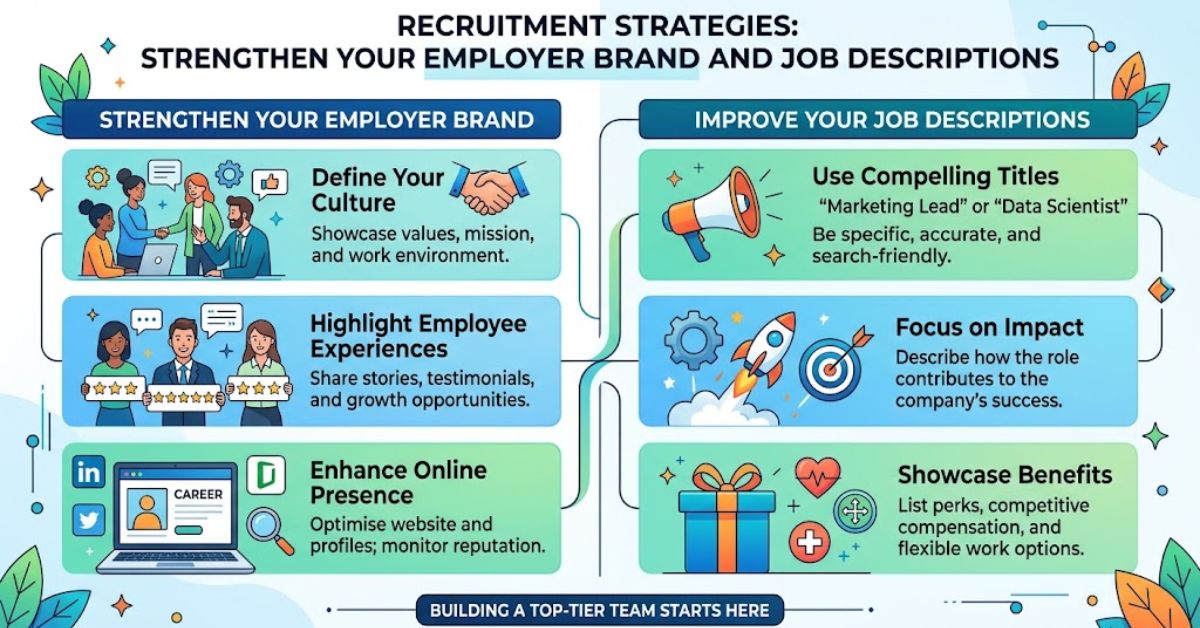
Your employer brand is the reputation people associate with your company as a place to work. Candidates often judge that reputation before they apply, so vague career pages and generic job ads create unnecessary friction. Show what daily work looks like, explain company values with specific examples, feature employee voices, and respond professionally to public feedback. Employer branding works best when the message candidates see online matches the experience they encounter during interviews.
Job descriptions should reinforce that same message. Use familiar job titles, open with the purpose of the role, separate must-have qualifications from nice-to-have skills, and explain what success looks like. Avoid inflated titles and endless responsibility lists. A strong posting helps the right candidate self-select while discouraging poor-fit applications. It should answer three practical questions quickly: What will I do, what do I need to succeed, and why is this opportunity worth considering?
Use Employee Referrals and Past Candidates
An employee referral program turns your existing workforce into a sourcing network. Employees already know former coworkers, classmates, vendors, and industry peers, which can make referrals a useful way to reach qualified people. Indeed notes that referral programs commonly use a reward or bonus to encourage participation. The program should be simple: publish open roles internally, explain who qualifies as a referral, define the reward, and tell employees when and how the reward is paid.
Do not stop with referrals. Reconnect with people who already know your company. Silver medalists—strong candidates who finished near the top of a previous hiring process—may fit a new opening without starting from zero. Boomerang employees can also be valuable when they left on good terms and gained useful experience elsewhere. Keep a searchable talent pool, record why each person was promising, and contact them only when a genuinely relevant role becomes available.
A practical referral process can follow these steps:
- Identify open positions that need referrals.
- Share clear role requirements with employees.
- Create a simple referral submission process.
- Review referred candidates using the normal hiring criteria.
- Keep the referring employee updated.
- Pay or provide the promised reward when eligibility requirements are met.
The mistake is treating referrals as automatic endorsements. Referred candidates should still go through a fair, job-related selection process.
Expand Recruiting Through Social Media and Niche Boards
Social recruiting expands your reach beyond candidates who are actively browsing job boards. LinkedIn and other professional networks can help recruiters identify people with specific backgrounds, follow industry conversations, and send targeted outreach. The message matters more than volume. A short note that explains why the person’s experience fits the role is stronger than a generic mass message. Social media can also reinforce employer branding by showing real teams, projects, events, and workplace practices.
Niche job boards are useful when the role requires specialized knowledge or serves a defined professional community. A cybersecurity opening, for example, may perform better on a security-focused board than on a broad site where it competes with thousands of unrelated listings. The same principle applies to trade, healthcare, design, academic, and technical roles. Test channels instead of assuming. Track qualified applicants, interview rate, cost per qualified candidate, and eventual hires by source.
| Recruiting Channel | Best Use | Main Limitation |
| General job boards | Broad applicant reach | Can create high screening volume |
| Employee referrals | Trusted professional networks | Limited by employee network size |
| LinkedIn outreach | Passive professional candidates | Requires personalized outreach |
| Niche job boards | Specialized skills | Smaller overall audience |
| Past candidates | Previously vetted talent | Database quality can decline over time |
| Career website | Employer-brand-driven applications | Depends on company visibility |
The best channel is not necessarily the one producing the most resumes. A source that sends 20 qualified candidates can be more valuable than one sending 500 poorly matched applications.
Use ATS and AI Without Removing Human Judgment
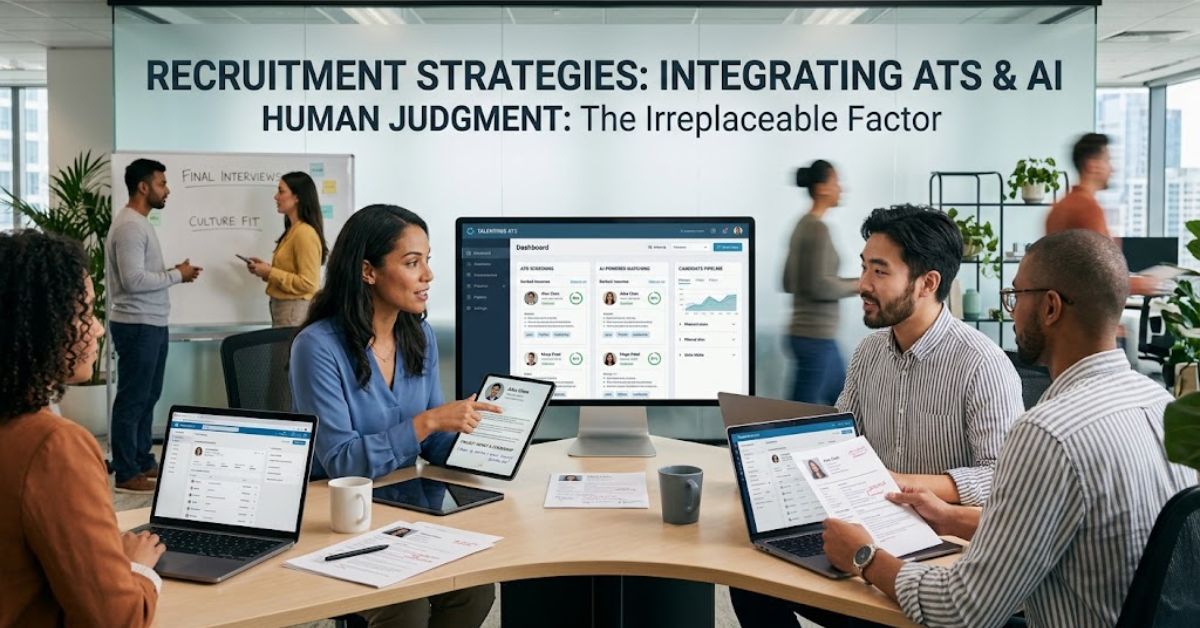
An Applicant Tracking System, or ATS, helps organize applications, hiring stages, interview notes, and candidate communication in one place. That makes it easier to maintain a consistent process when several people are hiring at once. Artificial intelligence can also support tasks such as resume parsing, matching, scheduling, and initial screening. The mistake is treating automation as a substitute for judgment. Technology should reduce administrative work and surface evidence, not make unreviewed decisions about people.
AI hiring tools also require oversight. The U.S. Equal Employment Opportunity Commission has warned that software, algorithms, and artificial intelligence used in employment decisions can create discrimination risks, including for applicants with disabilities. Employers should check whether screening criteria are job-related, test tools for unintended adverse effects, provide appropriate human review, and understand how vendors make recommendations. Faster screening is useful only when the process remains fair, explainable, and tied to actual job requirements.
Use automation for tasks such as:
- Organizing applications
- Scheduling interviews
- Sending status updates
- Parsing resumes
- Searching candidate databases
- Tracking recruiting metrics
Use human judgment for:
- Interpreting unusual career paths
- Reviewing assessment context
- Evaluating nuanced experience
- Conducting interviews
- Making final hiring decisions
AI should make recruiters more efficient, not remove accountability from the hiring process.
Make Skills-Based Hiring Part of Your Strategy
Skills-based hiring focuses on what a candidate can do rather than relying too heavily on degrees, former employers, or prestige signals. LinkedIn describes skills-first hiring as prioritizing competencies over credentials. For many roles, that means identifying the few capabilities that truly predict performance and building the hiring process around them. A work sample, role-specific task, portfolio review, or structured skills interview can reveal more useful evidence than a resume alone.
Keep assessments short, relevant, and consistent. Ask candidates applying for the same role the same core interview questions and use a scoring rubric before interviews begin. That reduces improvisation and makes comparisons clearer. Then measure whether your recruitment strategies actually work. Review time to hire, qualified-candidate rate, offer acceptance, new-hire performance, retention, and source effectiveness. A strategy that produces many applicants but few strong hires is not successful; it is simply generating more screening work.
For example, a company hiring a content writer could evaluate candidates with a short editing or writing exercise rather than rejecting everyone without a specific degree. A software team might use a realistic debugging exercise instead of an abstract test unrelated to daily work.
A simple skills-based hiring process looks like this:
- Identify the skills genuinely required on day one.
- Remove unnecessary degree or experience requirements.
- Create a job-related assessment.
- Use structured interview questions.
- Score candidates against predefined criteria.
- Compare hiring results with later job performance.
- Improve the process using actual performance data.
Conclusion
Effective recruitment strategies combine a clear employer message with disciplined sourcing and evidence-based selection. Build an employer brand people can understand, write job descriptions that explain the real work, use referrals and past candidates intelligently, and choose social or niche channels based on the role. Add an ATS and AI where they remove repetitive work, but keep human accountability and job relevance at the center of the hiring process.
The final step is measurement. Hiring teams should know which channels produce qualified candidates, which assessments predict success, where candidates drop out, and how long strong hires stay. Those signals show where the recruiting process needs improvement. There is no universal tactic that wins every time. The best recruitment strategies are the ones a company can test, measure, refine, and repeat as its workforce needs and labor market change.