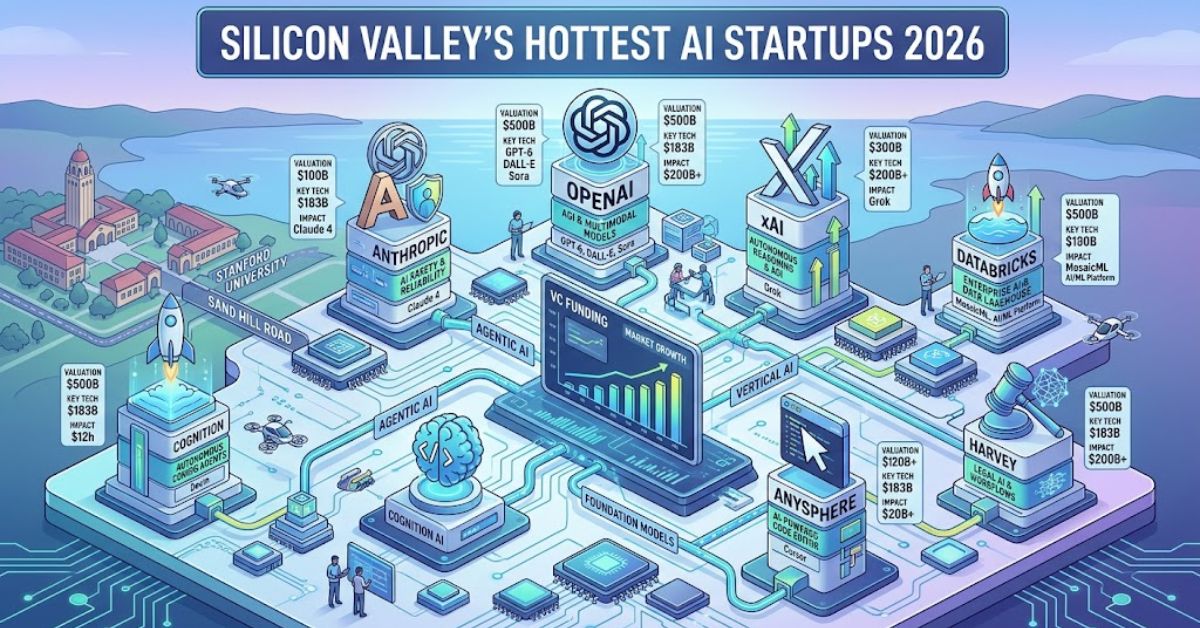
The Hottest AI Startups in Silicon Valley are no longer competing in one lane. The market now spans frontier models, autonomous coding, model customization, robotics, spatial intelligence, and enormous AI infrastructure. That makes a simple startup ranking less useful than understanding which companies are gaining technical or commercial leverage in each layer of the rapidly changing AI stack.
For this guide, “Silicon Valley” includes the broader San Francisco Bay Area AI ecosystem commonly associated with the term. It also discusses companies such as Skild AI and FieldAI that influence the same physical-AI market despite being headquartered outside Silicon Valley proper. That distinction matters because a useful industry guide should not distort geography simply to make a company fit a keyword.
Why Silicon Valley’s AI Startup Race Looks Different in 2026
The biggest shift is from chatbots alone toward systems that can act, build, perceive, reason, and control machines. Forbes’ 2026 AI 50 reflects this wider market, featuring companies working across frontier models, enterprise applications, robotics, and other specialized AI categories. World Labs is developing spatial intelligence while Physical Intelligence is pursuing general-purpose robotic models. The Hottest AI Startups in Silicon Valley therefore look increasingly different from the first generative-AI boom.
Investors and customers are also rewarding companies that control a difficult technical layer instead of merely wrapping someone else’s model. Defensibility can come from proprietary training, unique robotics data, deep workflow integration, world models, specialized infrastructure, or distribution. In practical terms, the strongest startups are attempting to turn research advantages into products customers repeatedly use and pay for, rather than relying entirely on impressive demos or fundraising announcements.
Major areas worth watching include:
- Agentic AI that completes multi-step tasks
- AI coding agents and developer tools
- Model customization and fine-tuning
- Robotics foundation models
- Spatial intelligence and world models
- Enterprise AI infrastructure
- Frontier-model training and inference
OpenAI and Anthropic Still Define the Frontier
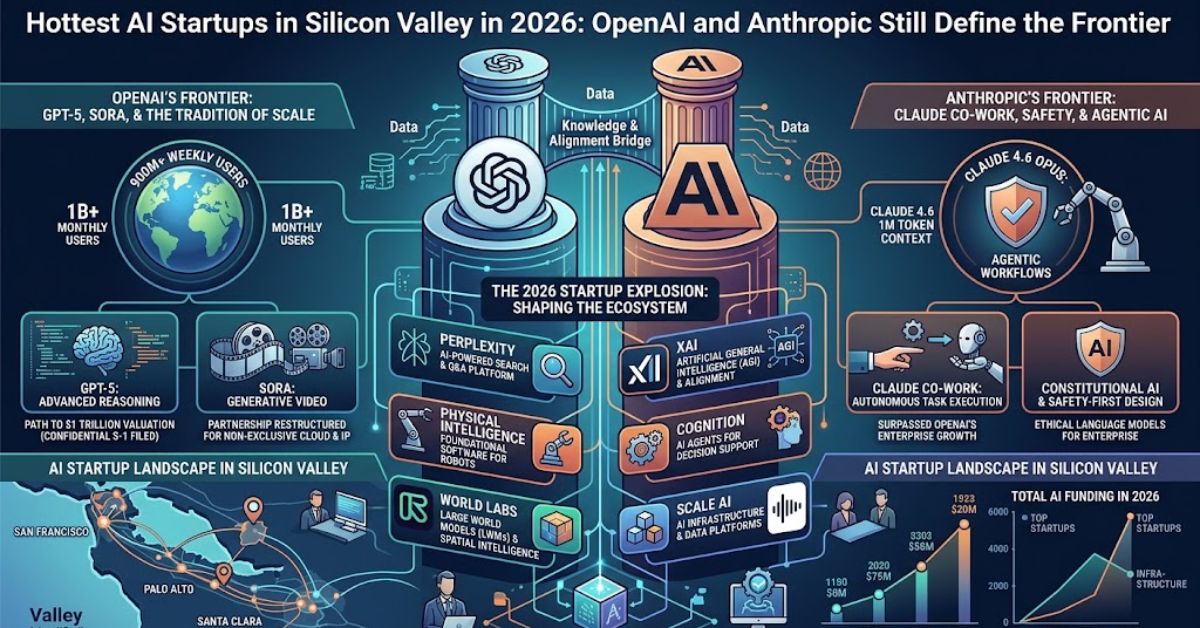
OpenAI and Anthropic remain two reference points for frontier AI, although calling either a conventional startup now stretches the definition. Anthropic followed with a $65 billion Series H announced in May 2026, giving it a reported $965 billion post-money valuation.
Their scale matters because companies throughout the AI ecosystem build applications, agents, infrastructure, and workflows around frontier-model capabilities. OpenAI reported more than $20 billion in annual recurring revenue for 2025, illustrating how quickly frontier AI has become a major commercial market. For anyone researching the Hottest AI Startups in Silicon Valley, these labs establish the capability benchmark against which newer companies are increasingly measured.
| Company | Core Focus | Why It Matters in 2026 |
|---|---|---|
| OpenAI | Frontier AI models | Massive capital, compute, products, and commercial scale |
| Anthropic | Frontier models and Claude | Major frontier competitor with a $65B Series H announced in 2026 |
| Thinking Machines Lab | Model training and customization | Tinker gives developers control over model training while infrastructure is managed for them |
| Physical Intelligence | Robotics foundation models | Building general-purpose intelligence intended to control robots across tasks |
| World Labs | Spatial intelligence | Developing persistent, editable AI-generated 3D environments |
AI Coding Is Becoming an Agent Market
AI coding is one of the clearest markets where agentic AI is becoming paid software rather than an experimental feature. Cognition’s Devin is designed as a software-engineering agent for complex development projects, while Devin Review helps developers inspect pull requests, identify issues, and understand AI-generated code. Cursor similarly helped establish AI-native coding workflows, moving developers from autocomplete toward agents that can participate in larger engineering tasks.
Cursor requires an important 2026 update. SpaceX completed its $60 billion acquisition of Anysphere, Cursor’s parent company, on August 14, 2026. That means Cursor remains crucial to understanding the AI coding boom but is no longer an independent startup. Thinking Machines Lab, meanwhile, offers Tinker for model training and fine-tuning and released its Inkling open-weights model family in July 2026, creating another developer-focused approach to AI customization.
Key developer-AI companies now represent different approaches:
- Cognition AI: autonomous software-engineering workflows
- Cursor: AI-native coding and software agents, now owned by SpaceX
- Thinking Machines Lab: model training, customization, and frontier research
- OpenAI and Anthropic: underlying frontier models increasingly capable of coding and agentic work
This distinction matters. The long-term winner may not simply be the tool that generates the most code. The bigger opportunity could belong to companies that own the workflow where humans assign, review, test, and approve increasingly autonomous software agents.
Physical AI and Robotics Are the Next Major Battleground
Physical Intelligence is one of the clearest examples of physical-world AI moving beyond narrow automation. The San Francisco company is developing general-purpose models designed to control robots across different tasks and environments. Its research includes vision-language-action systems and methods aimed at stronger real-world generalization. Forbes reports that Physical Intelligence has raised $1 billion, reflecting substantial investor interest in robotics foundation models as a potential platform technology.
Skild AI and FieldAI demonstrate how broad the robotics competition has become. Skild says its Skild Brain is designed as a unified robotics foundation model across different hardware forms and announced a $1.4 billion Series C in January 2026. FieldAI develops risk-aware foundation models for robots operating in unpredictable environments and announced more than $400 million in funding in 2025. Neither should be mislabeled as a Silicon Valley-headquartered startup.
| Physical AI Company | Main Approach | Geographic Note |
| Physical Intelligence | General-purpose robot foundation models | San Francisco-based |
| Skild AI | One AI “brain” across multiple robot types | Pittsburgh HQ with a San Francisco presence |
| FieldAI | Risk-aware autonomy for unpredictable environments | Headquartered in Irvine, California |
The common theme is generalization. Traditional automation often requires engineering one machine for one controlled task. These companies are instead trying to build intelligence that can transfer across machines, environments, or activities. If that approach works reliably at commercial scale, robotics could become one of the largest new AI software markets.
World Labs Is Betting That AI Needs Spatial Intelligence
World Labs, founded by AI pioneer Fei-Fei Li alongside Justin Johnson, Christoph Lassner, and Ben Mildenhall, is building AI that can represent and generate three-dimensional environments. Its first major product, Marble, creates persistent and editable 3D worlds using text, images, video, 360-degree panoramas, and other inputs. The company announced another $1 billion in funding in February 2026 to accelerate its work on spatial intelligence.
The opportunity goes beyond generating attractive virtual scenes. Spatial models could help AI represent depth, geometry, movement, objects, and relationships inside physical environments. World Labs explicitly connects its technology with creativity, robotics, scientific discovery, and simulation. That makes world models especially interesting because robots ultimately need more than language: they need usable representations of the environments where actions happen.
Why spatial intelligence matters:
- Robots need to understand physical geometry.
- Games and creative tools need editable 3D environments.
- Simulations can create training environments for autonomous systems.
- AI systems need persistent representations of spaces, not only isolated images.
- World models may connect generative AI with robotics and embodied intelligence.
That combination makes World Labs one of the most distinctive companies among the Hottest AI Startups in Silicon Valley because it is targeting a problem fundamentally different from generating better text responses.
Infrastructure Scale Is Changing Who Can Compete
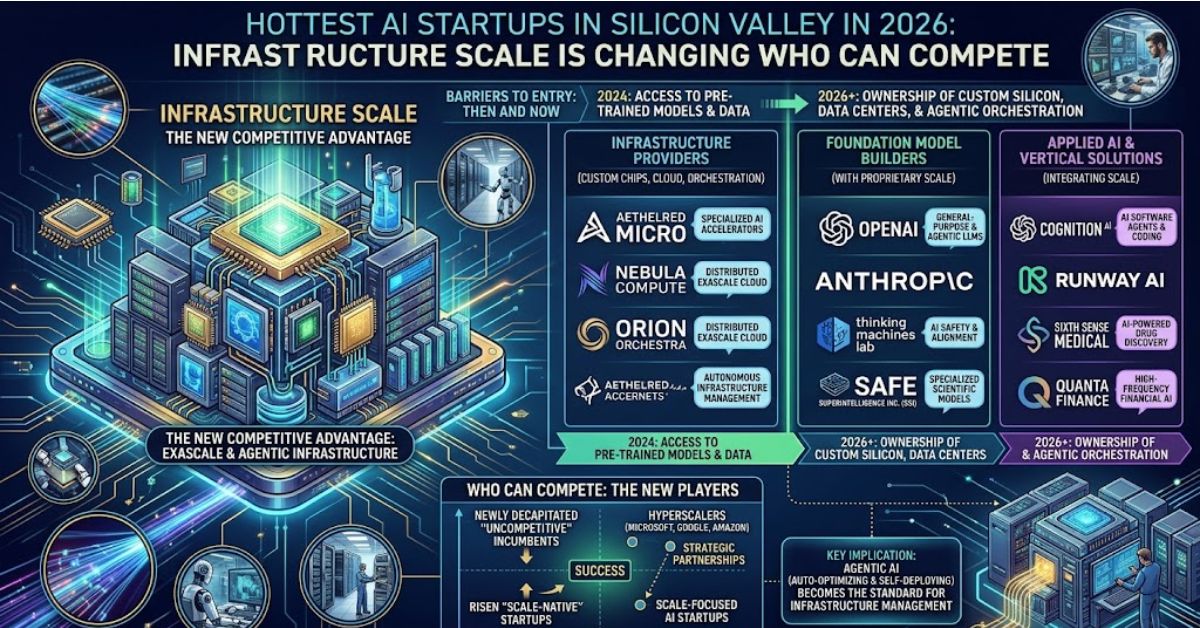
xAI deserves inclusion in the AI landscape, but its current corporate status matters. SpaceX formally acquired xAI in February 2026, meaning it is no longer a standalone AI startup. The combined AI operation now appears under the SpaceXAI identity. Its Colossus infrastructure originally linked 200,000 H100 GPUs, while later company information described Colossus 1 as containing more than 220,000 Nvidia GPUs across H100, H200, and GB200 systems.
Databricks also sits well beyond the traditional startup stage, yet it remains important to the Bay Area AI ecosystem because enterprise AI depends heavily on data infrastructure. In February 2026, Databricks announced that it had exceeded a $5.4 billion revenue run-rate while completing more than $7 billion in investments at a $134 billion valuation. Those numbers are substantially newer than the roughly $3.7 billion figure that appeared in earlier discussions of the company.
The infrastructure race matters because advanced AI requires more than a strong model. Companies increasingly need:
- Large-scale compute for training and inference.
- Reliable data pipelines and governance.
- Model evaluation and deployment systems.
- Enterprise security and access controls.
- Monitoring for production AI workloads.
- Affordable inference as usage scales.
| AI Layer | Companies to Watch | Competitive Advantage |
| Frontier models | OpenAI, Anthropic | Model capabilities and compute scale |
| AI coding | Cognition, Cursor | Developer workflow and agent adoption |
| Customization | Thinking Machines Lab | Training APIs and model control |
| Robotics | Physical Intelligence, Skild AI, FieldAI | Physical data and embodied intelligence |
| Spatial AI | World Labs | 3D world models and spatial reasoning |
| Infrastructure | Databricks, SpaceXAI | Data systems and large-scale compute |
How to Identify the Hottest AI Startups in Silicon Valley
A serious ranking should look beyond funding announcements. Start with product adoption and then ask whether a company owns differentiated technology, proprietary data, distribution, workflow integration, or infrastructure. Next, determine whether it solves an expensive problem that customers repeatedly pay to fix. Finally, consider what happens if frontier models become dramatically cheaper and stronger. A product that disappears as base models improve probably has less defensibility than its valuation suggests.
That framework explains many of today’s leaders. World Labs owns a distinctive spatial-intelligence direction. Physical Intelligence is pursuing robot foundation models. Cognition is pushing agents deeper into software-engineering workflows. Thinking Machines Lab is targeting model customization and research infrastructure. OpenAI and Anthropic remain frontier anchors, while Databricks and SpaceXAI demonstrate what extreme infrastructure scale looks like. The Hottest AI Startups in Silicon Valley are increasingly defined by which valuable layer they can control.
Conclusion
The Hottest AI Startups in Silicon Valley in 2026 span several major fronts: frontier models, AI coding, model customization, robotics, spatial intelligence, and infrastructure. OpenAI and Anthropic remain powerful frontier benchmarks, while Thinking Machines Lab, World Labs, Physical Intelligence, and Cognition are pursuing more specialized advantages. Each represents a different bet on where lasting value will emerge as artificial intelligence moves deeper into software and the physical world.
The larger lesson is that “hot” should not simply mean “raised the most money.” A stronger signal is whether a company controls technology, data, distribution, infrastructure, or workflow that remains valuable as AI models improve. Cursor’s August 2026 acquisition and xAI’s February integration into SpaceX show how quickly corporate status can change. Anyone tracking the Hottest AI Startups in Silicon Valley should follow product traction as closely as funding headlines.