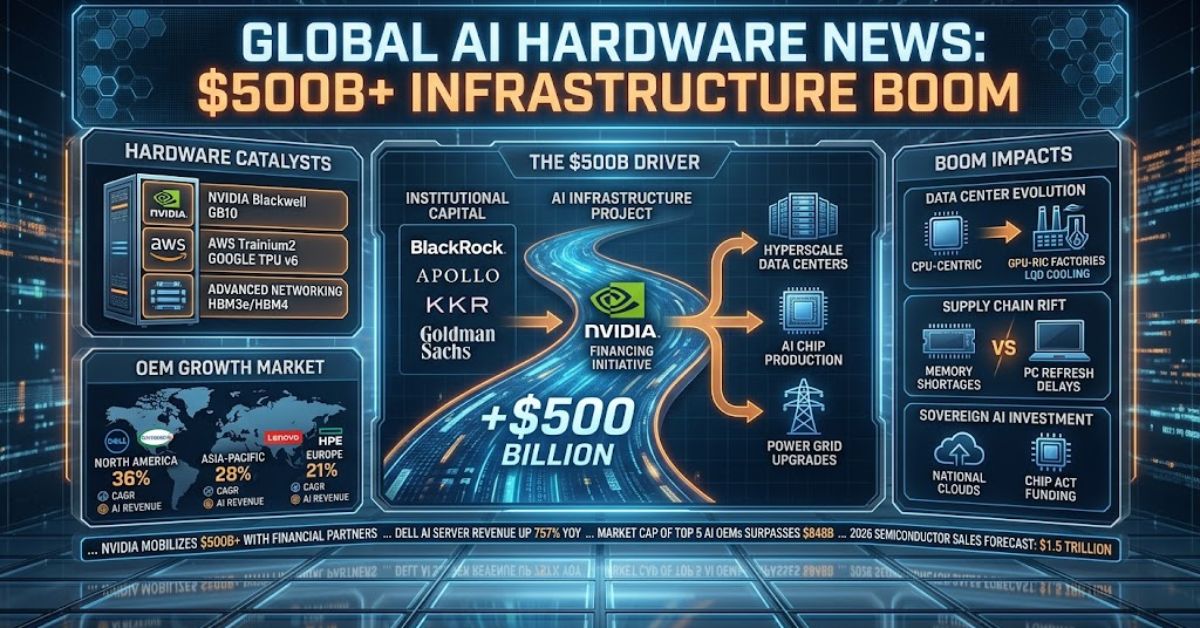
AI Hardware News in August 2026 is no longer just about which company has the fastest accelerator. The bigger story is the infrastructure system forming around those chips: financing, power, cooling, networking, manufacturing and security. Nvidia is helping mobilize more than $500 billion in third-party financing, while major chipmakers and cloud companies are redesigning hardware around the economics of inference rather than training alone.
That shift matters because AI is moving from a model-building phase toward a model-running phase. Deloitte projected that inference would account for roughly two-thirds of AI compute in 2026, not two-thirds of hardware spending. That distinction is important. As inference grows, buyers increasingly care about tokens per watt, memory efficiency, latency, deployment cost and software compatibility instead of peak benchmark performance alone.
Wall Street Opens a $500 Billion AI Infrastructure Pipeline
Nvidia has partnered with Apollo, BlackRock, Blackstone, Brookfield, Goldman Sachs and KKR on financing platforms intended to make more than $500 billion available for AI infrastructure. This is not a single KKR-run “megafund.” It is a broader financing initiative designed to help AI labs, cloud operators and other customers fund expensive compute projects while reducing the amount of capital Nvidia must supply directly.
The scale reflects how capital-intensive the AI buildout has become. Reuters reported that Alphabet, Amazon, Meta, Microsoft and Oracle were collectively expected to spend about $750 billion on data centers in 2026. That money reaches far beyond GPUs. It supports power generation, substations, liquid cooling, networking, advanced packaging, server racks, land, construction and the specialized facilities required to keep high-density AI systems operating reliably.
Key areas receiving capital include:
- AI data centers and “AI factories”
- High-density power and electrical infrastructure
- Liquid-cooling systems
- Networking and optical interconnects
- Advanced semiconductor manufacturing
- GPU and accelerator leasing or financing
Inference Hardware Becomes the New Battleground
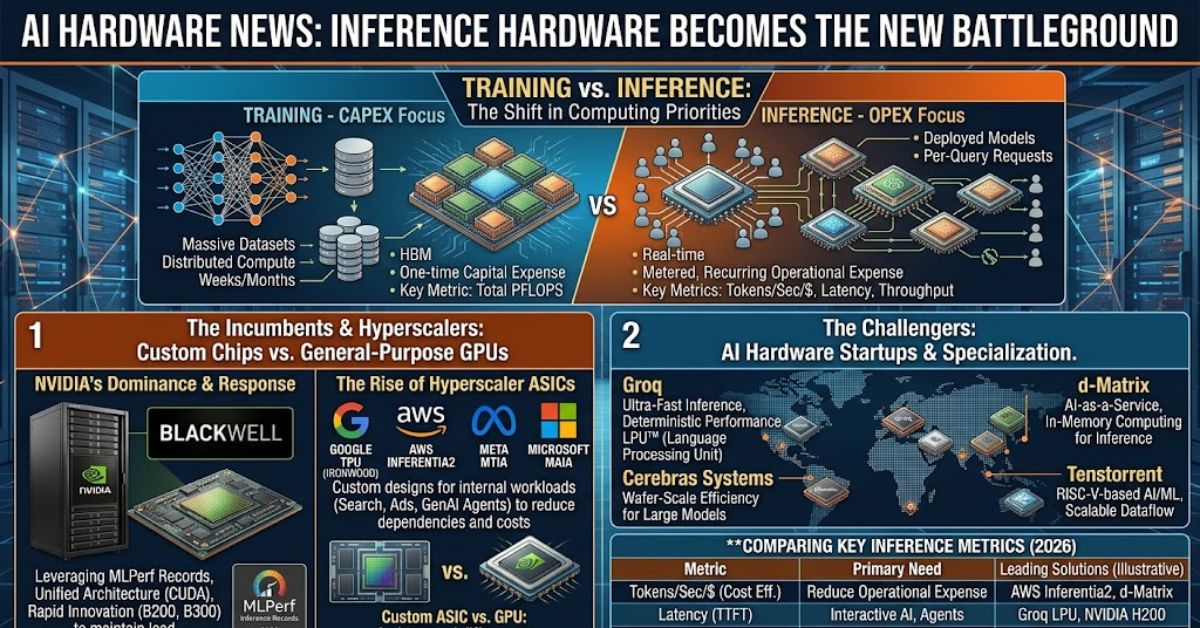
Training frontier models still requires enormous clusters, but inference changes the economics. A training system may prioritize maximum throughput during a limited development cycle. An inference platform must answer user requests continuously and economically. That makes latency, memory capacity, memory bandwidth, utilization and energy efficiency critical. A chip that produces more useful tokens from each watt and dollar can become more valuable than one that simply posts a higher peak compute number.
This is why the AI Hardware News cycle is increasingly filled with inference-specific processors, lower-precision formats and tightly integrated systems. Google’s TPU 8i, for example, is positioned for low-latency inference and agentic workloads. OpenAI’s new processor is also built specifically around LLM inference. The market is moving toward heterogeneous architectures in which CPUs, GPUs, custom ASICs, memory and networking are optimized together rather than treated as separate components.
For buyers, the most useful inference metrics now include:
- Tokens per second
- Tokens per watt
- Cost per million tokens
- Time to first token
- Memory capacity and bandwidth
- Model size supported per server
- Software stack maturity
AMD, Google and OpenAI Push Custom Silicon Forward
AMD is expanding beyond standalone accelerators toward full rack-scale AI systems. Its Instinct MI455X is based on the CDNA 5 architecture, and AMD lists TSMC 2nm and 3nm FinFET technologies for the product. AMD also reported second-quarter data-center revenue of $6.72 billion, more than double the year-earlier level. The company is positioning Helios systems as a broader alternative to Nvidia’s integrated AI infrastructure approach.
Google’s next move is less certain. Tom’s Hardware reported that Google may work with AMD on a future TPU design that could integrate CPU cores more tightly with TPU chiplets for reinforcement-learning and agentic workloads. That collaboration has been reported rather than officially confirmed. Google has officially introduced TPU 8t and TPU 8i, with the latter focused on low-latency inference and greater energy efficiency for agentic AI services.
OpenAI’s custom chip story also needs one factual correction. The Broadcom collaboration is not codenamed “Alipino.” OpenAI officially unveiled Jalapeño in June 2026, describing it as its first Intelligence Processor and an accelerator designed for LLM inference. OpenAI says the first generation is aimed at better performance per watt and that deployment is planned to begin in late 2026 as part of a multi-generation compute platform.
TSMC and Cisco Show the Boom’s Supply-Chain Reality
TSMC’s July numbers show why advanced manufacturing remains one of the strongest pressure points in AI hardware. The foundry reported July 2026 revenue of NT$467.58 billion, up 44.7% from July 2025 and 5.6% from June. Because TSMC manufactures advanced processors for companies across the AI ecosystem, that growth is a useful signal that demand for leading-edge fabrication technologies remains extremely strong.
Cisco shows the other side of the boom. It reported $9.3 billion in AI infrastructure orders from hyperscalers during fiscal 2026, including $4 billion in the fourth quarter. Yet strong hardware demand can pressure profitability. Cisco’s adjusted gross margin was 66.3% in the quarter, down from 68.4% a year earlier, while guidance pointed to 65%–66% as component costs and a hardware-heavy sales mix weighed on margins.
AI Hardware Market Comparison
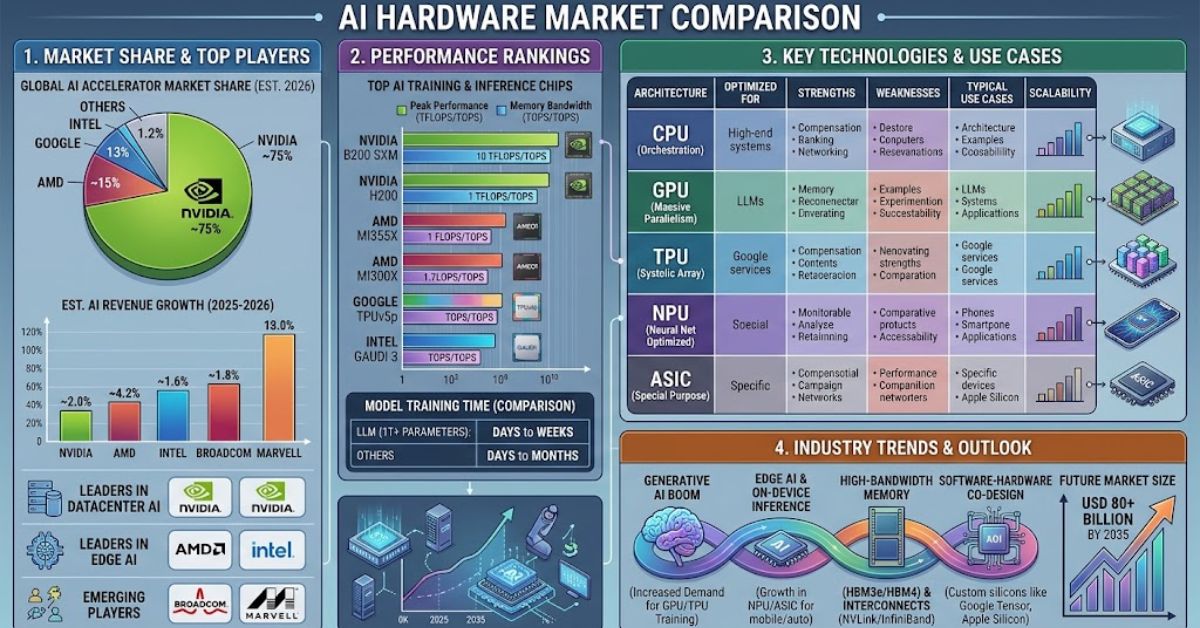
The market is no longer a simple GPU race. Each major player is attacking a different part of the stack. Nvidia combines accelerators, networking, software and financing. AMD is building rack-scale alternatives. Google is expanding its TPU family. OpenAI is moving into custom inference silicon. TSMC supplies the manufacturing backbone, while Cisco sells networking infrastructure that connects increasingly dense clusters. Competitive advantage is spreading across the entire AI system.
The table below summarizes the most important developments shaping AI Hardware News in August 2026. It also shows why comparing raw chip specifications alone is becoming less useful. A successful deployment depends on the interaction between silicon, memory, networking, cooling, software, power availability and financing.
| Company | August 2026 hardware position | Main significance |
|---|---|---|
| Nvidia | $500B+ financing initiative with Wall Street partners | Expands access to Nvidia-centered infrastructure |
| AMD | MI455X and Helios rack-scale systems | Pushes a full-stack alternative for training and inference |
| TPU 8i and reported AMD work on future TPU design | Targets agentic and low-latency AI workloads | |
| OpenAI | Jalapeño inference processor with Broadcom | Custom silicon designed around LLM inference |
| TSMC | July revenue up 44.7% year over year | Shows continuing advanced-fabrication demand |
| Cisco | $9.3B FY2026 AI infrastructure orders | Highlights networking demand and margin tradeoffs |
Training Hardware vs. Inference Hardware
| Factor | AI Training | AI Inference |
| Main goal | Build or fine-tune models | Run trained models for users |
| Key priority | Maximum cluster throughput | Cost-efficient continuous serving |
| Important metrics | FLOPS, scaling efficiency | Tokens/sec, tokens/watt, latency |
| Memory needs | Large and distributed | Highly workload-dependent |
| Power focus | Maximum performance | Performance per watt |
| Cost focus | Training run cost | Cost per request or token |
| Typical architecture | Large GPU/accelerator clusters | GPUs, ASICs and specialized accelerators |
Security, Financing and Deployment Risks
The AI boom is creating risks that rarely appeared in earlier chip cycles. WIRED reported violent cargo thefts involving high-value AI hardware shipments in California, including attacks in which security escorts were disabled by deliberate vehicle collisions. Restricted Nvidia systems can command extreme black-market prices overseas. A DGX B300 system has been reported at roughly $1.1 million in China’s gray or black market, versus around $400,000 in the United States.
Financial and operational risks are just as important. AI servers can lose economic value quickly while infrastructure financing can extend for years. Power connections, cooling equipment, permitting and construction can delay deployments even after processors become available. That creates a mismatch between fast hardware cycles and slow infrastructure cycles. Companies therefore need to evaluate total deployment economics rather than assuming that purchasing more accelerators automatically produces more useful AI capacity.
Before committing to a major AI hardware purchase, decision-makers should:
- Define the workload split between training and inference.
- Measure expected tokens per second and tokens per watt.
- Check power, cooling and rack-density limits.
- Model software migration and compatibility costs.
- Verify supply, delivery and security requirements.
- Compare financing terms with the hardware’s useful life.
Conclusion
The clearest message from AI Hardware News in August 2026 is that the industry is becoming an infrastructure business, not just a semiconductor business. Nvidia’s financing strategy, AMD’s rack-scale push, Google’s TPU roadmap, OpenAI’s Jalapeño processor, TSMC’s revenue growth and Cisco’s order momentum all point in the same direction: AI compute is expanding into a tightly connected market spanning chips, networking, power, cooling and capital.
The second message is that inference efficiency is becoming a central competitive metric. As more AI workloads move into continuous production, buyers will judge hardware by useful output per dollar and watt, not only theoretical peak performance. That favors specialized architectures and better system integration. For companies following AI Hardware News, the smartest question is no longer “Which chip is fastest?” It is “Which complete system delivers the best economics for our workload?”