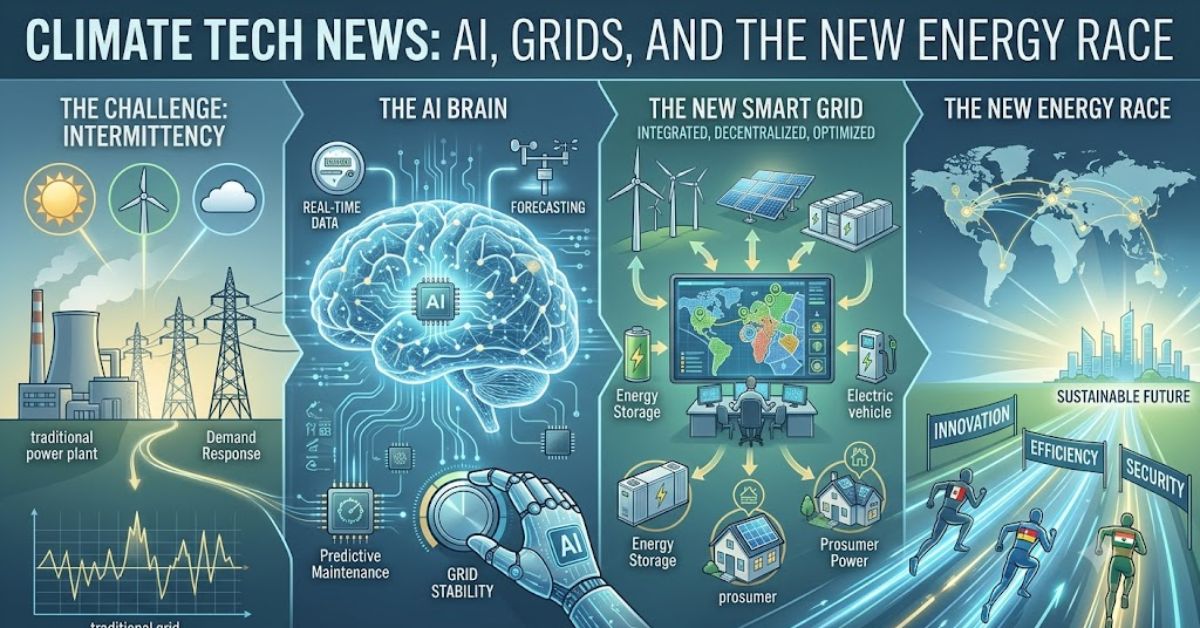
The climate technology market is no longer driven mainly by experimental ideas and distant promises. The latest Climate Tech News shows a sector being reshaped by immediate electricity demand, grid constraints, corporate emissions targets, and investor pressure for measurable results. AI data centers are increasing power requirements, while utilities and governments struggle to expand generation, transmission, and energy storage quickly enough.
Three forces now define the market: AI energy demand, infrastructure execution, and corporate decarbonization. Capital is still available, but investors are becoming far more selective. They want technologies that can reach commercial scale, secure customers, connect to the grid, and generate dependable revenue. That shift is creating opportunities for grid software, renewable power, battery storage, carbon accounting, industrial efficiency, and climate-resilience tools.
AI Power Demand Becomes Climate Tech’s Biggest Test
Global data centers consumed an estimated 415 terawatt-hours of electricity in 2024, equal to about 1.5% of worldwide electricity use. That figure is lower than the frequently repeated 500-terawatt-hour estimate. However, the International Energy Agency expects data-center demand to reach approximately 945 terawatt-hours by 2030, with consumption growing about 15% annually.
The problem is not only the total amount of energy consumed. Data centers tend to cluster in specific regions, creating intense local pressure on utilities, transmission systems, water supplies, and power prices. A data center may be built within two or three years, while new transmission lines and generating facilities often require much longer planning, permitting, and construction schedules.
Microsoft’s 2026 sustainability reporting demonstrates the scale of the challenge. Its total Scope 1, Scope 2, and Scope 3 emissions increased 25% year over year, primarily because of data-center expansion and a decision to stop relying on certain unbundled renewable energy certificates. The company said it would instead prioritize investments that add new carbon-free electricity to power grids.
| AI energy challenge | Climate technology opportunity |
|---|---|
| Concentrated electricity demand | Grid expansion and substation upgrades |
| Variable renewable generation | Battery storage and demand flexibility |
| Rising data-center emissions | Carbon-free power procurement |
| Limited local grid capacity | Microgrids and distributed energy |
| High cooling requirements | Efficient cooling and water systems |
The central question is no longer whether AI uses significant energy. It does. The more useful question is whether AI infrastructure can support new clean generation rather than simply consuming electricity already available on the grid.
Grid Infrastructure Moves to the Center of Investment
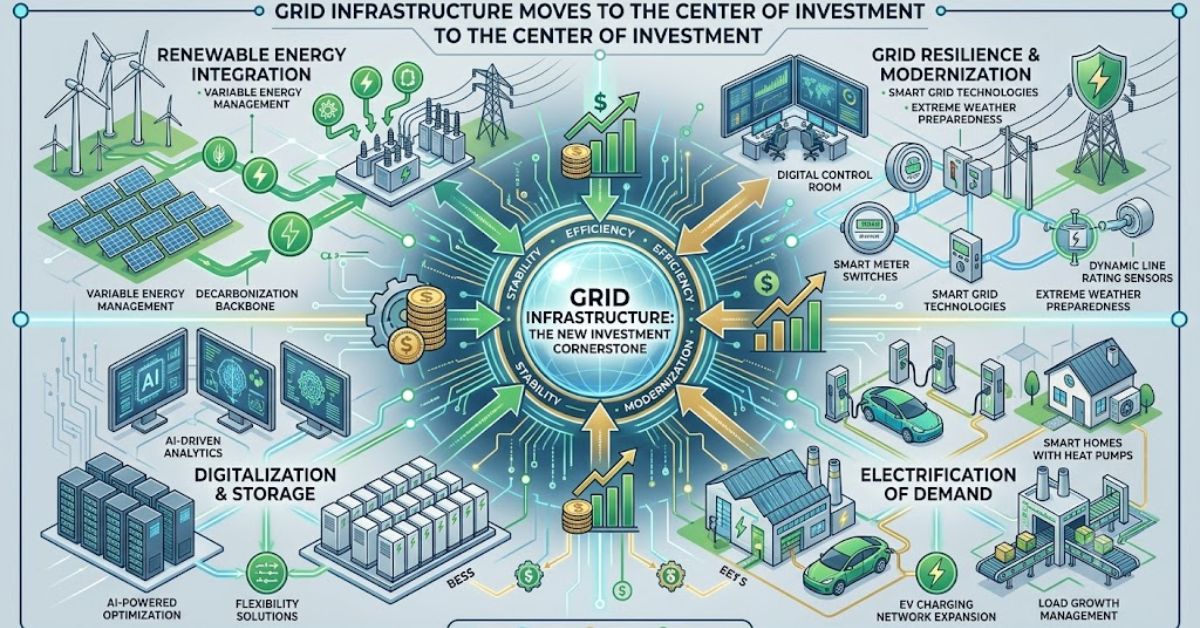
Grid infrastructure has become one of the most important areas in Climate Tech News. Renewable energy capacity can grow rapidly, but electricity has limited value when projects cannot secure transmission access, storage capacity, or dependable buyers. Investors are therefore looking beyond individual solar panels and wind turbines toward entire power systems that can deliver reliable electricity at utility scale.
Funding is moving into grid optimization, virtual power plants, battery storage, flexible demand, nuclear energy, and firm low-carbon generation. Climate investment research found that energy represented 36% of global climate venture and growth funding in 2025. The sector attracted $14.4 billion, a 31% increase from the previous year, as investors responded to growing demand for resilient power systems.
Large renewable projects are also securing substantial debt and project financing. Exus Renewables North America completed $308.2 million in financing in July 2025, not the widely repeated $365 million figure. The transactions covered a 185-megawatt solar portfolio in New Mexico and a 169-megawatt wind portfolio in Pennsylvania.
The Exus example matters because it demonstrates what infrastructure investors now demand:
- Operating or construction-ready assets
- Long-term power purchase agreements
- Experienced development and operating teams
- Clearly defined revenue sources
- Proven grid connections
- Projects large enough to affect regional power supply
Climate technologies that cannot demonstrate these fundamentals will struggle to obtain affordable capital, regardless of how impressive their laboratory results appear.
Climate Venture Capital Rewards Scale and Execution
It became more concentrated. Global venture and growth investment reached approximately $40.5 billion, an 8% annual increase. At the same time, deal count fell 18%, showing that investors placed larger checks into fewer companies rather than spreading capital across numerous experimental startups.
The same pattern appeared in the United States. U.S. climate technology companies attracted $29 billion in venture investment during 2025, the third-highest annual total recorded. However, only 10 large deals captured 28% of the total. Meanwhile, 52% of venture-backed climate companies reduced their net cash burn as founders focused on margins, manufacturing efficiency, and profitability.
It is inaccurate to say that software completely dominates climate funding. Software companies often raise capital more easily because they can grow with less equipment and lower construction costs. However, the largest funding rounds are increasingly going to energy infrastructure, nuclear technology, battery systems, and commercially proven physical assets.
| Investment factor | Climate software | Hardware and infrastructure |
| Upfront capital | Usually lower | Usually much higher |
| Development timeline | Months to a few years | Several years |
| Main funding source | Venture and growth equity | Equity, debt, grants, project finance |
| Key proof point | Customer growth and recurring revenue | Bankability and commercial operation |
| Main risk | Weak differentiation | Construction and scaling risk |
| Current opportunity | Grid software and carbon data | Power, storage, industrial systems |
Early-stage startups face the hardest conditions. Seed investment fell 20% in 2025, while Series A investment declined 7%. Investors are no longer willing to fund several nearly identical companies in crowded categories. They increasingly expect defensible technology, commercial contracts, realistic manufacturing plans, and a credible route from pilot projects to full deployment.
AI Climate Tools Move From Pilots to Operations
AI is not only creating electricity demand. It is also becoming a practical climate mitigation and adaptation tool. Predictive weather modeling, grid forecasting, building optimization, satellite analysis, and agricultural intelligence can process data faster than traditional manual systems. The strongest applications do not replace scientists or infrastructure operators. They help them make faster and better-informed decisions.
Google DeepMind’s GenCast model illustrates the progress in AI weather forecasting. It produces probabilistic forecasts up to 15 days ahead and outperformed the European Centre for Medium-Range Weather Forecasts’ operational ensemble system across 97.2% of the tested forecasting targets. Better forecasts can improve preparations for extreme heat, cold, wind, and tropical weather.
Google also reports that its flood-forecasting information now covers more than two billion people across approximately 150 countries for significant river-flood events. These systems can help emergency agencies identify vulnerable areas, allocate resources, and issue earlier warnings. However, AI outputs should support official weather services rather than replace their warnings or local expertise.
Agriculture presents another promising use case. AI models can combine genetics, soil conditions, historical yields, temperature, rainfall, and management practices to identify promising seed varieties and testing locations. This can reduce wasted experiments and narrow the number of candidates that require expensive field testing.
The claim that AI can entirely bypass multi-year field trials is exaggerated. Crops still require real-world validation across seasons and environments. AI can shorten the discovery process and prioritize stronger candidates, but it cannot reliably replace agronomists, biological testing, or commercial growing trials.
Useful AI-driven climate applications include:
- Extreme-weather risk forecasting
- Flood mapping and early warnings
- Renewable energy production forecasting
- Building energy optimization
- Methane and pollution detection
- Crop-yield prediction
- Soil-carbon mapping
- Supply-chain emissions analysis
Corporate Carbon Targets Reshape Supply Chains
Corporate carbon commitments are becoming commercial requirements rather than public-relations statements. Large companies increasingly require suppliers to measure energy use, disclose greenhouse gas emissions, purchase cleaner electricity, reduce material waste, and submit decarbonization plans. This trend is increasing demand for carbon accounting software, supply-chain traceability, lifecycle analysis, and low-carbon manufacturing.
Telefónica’s climate plan provides a clear example. The telecommunications company aims to reduce its Scope 1 and Scope 2 emissions by 90% by 2030. It also plans to cut Scope 3 value-chain emissions by 56% and reach net-zero emissions across its value chain by 2040.
The three emissions categories affect different parts of a company:
- Scope 1 covers emissions from sources a company directly owns or controls.
- Scope 2 covers emissions connected with purchased electricity and energy.
- Scope 3 covers indirect emissions across suppliers, transportation, products, and other value-chain activities.
Corporate mandates generally move through four stages:
- The company establishes science-based carbon targets.
- Business units calculate their operational emissions.
- Suppliers receive reporting and reduction requirements.
- Procurement decisions begin favoring lower-carbon vendors.
Scope 3 is usually the most difficult area because companies depend on thousands of outside manufacturers, logistics providers, construction contractors, and technology vendors. That creates a large market for reliable emissions data, supplier engagement platforms, energy-efficiency systems, recycled materials, and industrial decarbonization services.
What Investors and Companies Should Watch Next
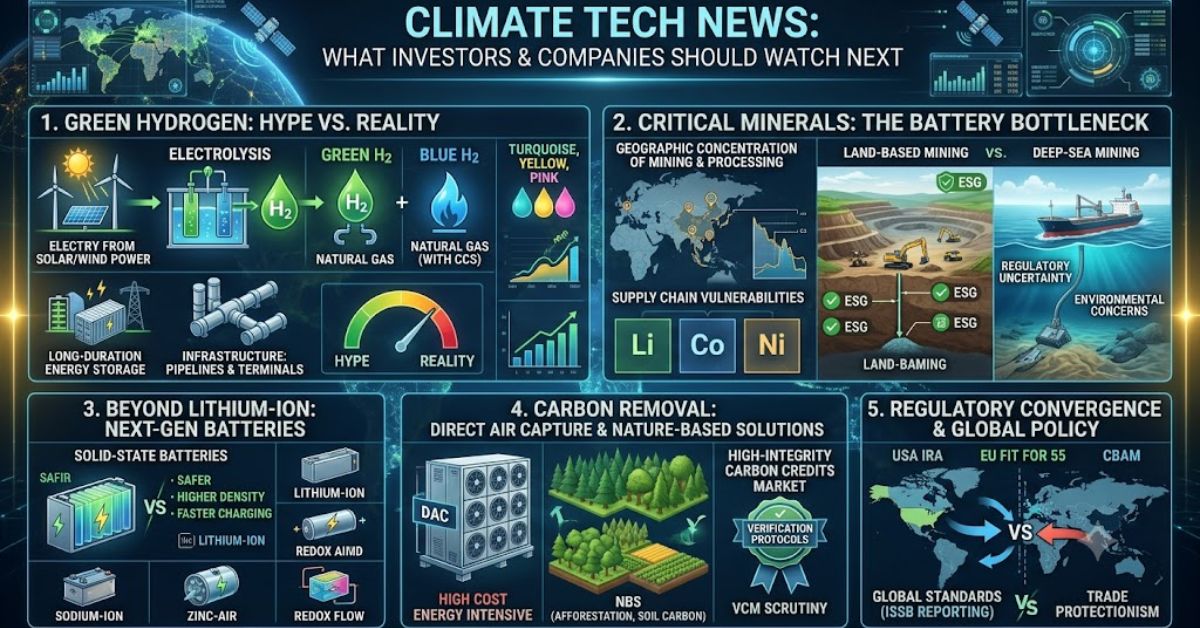
The next phase of the climate technology market will reward technologies connected to unavoidable economic demand. Grid reliability, electricity generation, data-center construction, industrial efficiency, water resilience, and supply-chain compliance are not optional problems. Companies and governments must address them even when political support for climate policy changes.
The latest Climate Tech News also shows that environmental benefits alone are rarely enough to support a business. A strong climate company must reduce costs, increase energy reliability, satisfy regulation, prevent operational disruption, or create a valuable new revenue stream. Carbon reduction should strengthen the business case rather than serve as its only justification.
Investors should examine the following checklist before backing a climate technology company:
- Does the product solve an urgent customer problem?
- Can it operate outside a controlled pilot environment?
- Are customers willing to sign long-term contracts?
- Does the company have access to grid capacity?
- Can manufacturing expand without destroying margins?
- Are emissions reductions independently measurable?
- Does the business depend on one temporary subsidy?
- Can the project attract debt or infrastructure capital?
Companies buying climate technology should apply similar standards. They should demand credible performance data, realistic installation schedules, transparent carbon calculations, cybersecurity safeguards, and evidence that the supplier can support the product for many years.
Conclusion
Climate technology is entering a more disciplined stage. AI energy demand, grid congestion, renewable deployment, energy storage, corporate carbon mandates, and national energy security are pushing the sector toward large-scale execution. Funding has not vanished, but it is increasingly concentrated among companies that can demonstrate commercial demand, reliable technology, defensible economics, and clear deployment pathways.
The most important Climate Tech News is therefore not another experimental breakthrough. It is the transition from promising pilots to functioning power systems, resilient infrastructure, measurable emissions reductions, and profitable climate businesses. The winners will be companies that connect environmental value with immediate economic necessity.